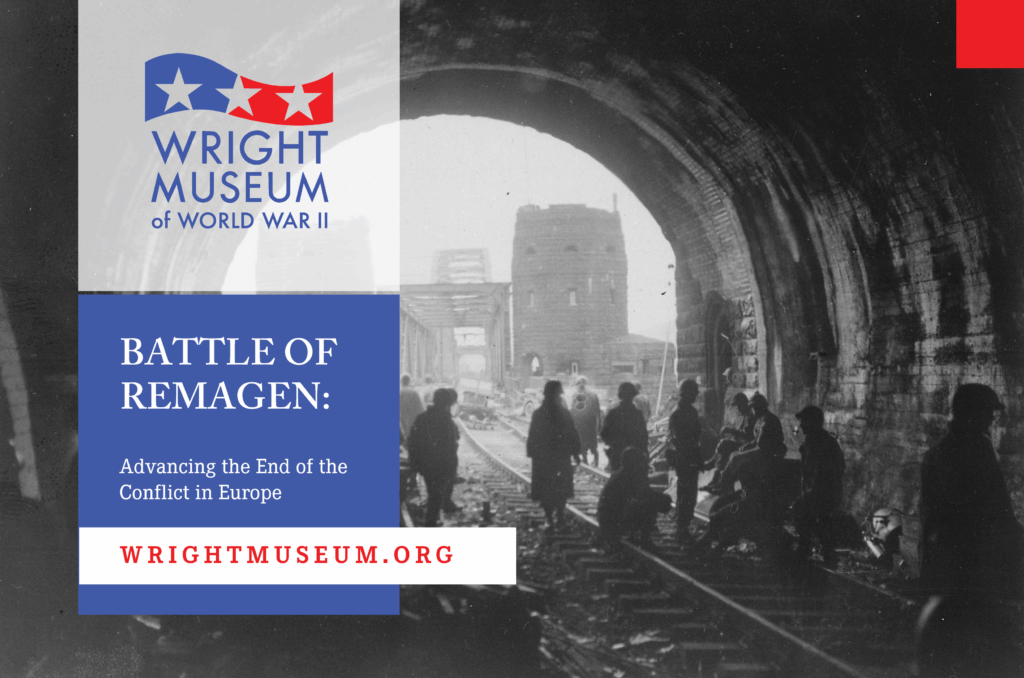
Nine months after D-Day, on March 7, 1945, American soldiers encountered an unexpected opportunity roughly 14 miles south of Bonn, Germany. As Allied troops advanced across France and into Germany, with the eventual goal of reaching Berlin, the U.S. Army’s 9th Armored Division, serving under the U.S. First Army, encountered the last bridge standing across the Rhine River, providing access to the heart of industrial Germany.
For months, Allied troops had been systematically destroying bridges across the Rhine in an effort to undermine German supply lines to the front. With the success of the D-Day invasion, Allied forces now faced the challenge of crossing the Rhine to continue their march on Berlin. Under the command of Brigadier General William M. Hoge, the 9th Armored Division happened upon the Ludendorff Bridge located in the town of Remagen, Germany.
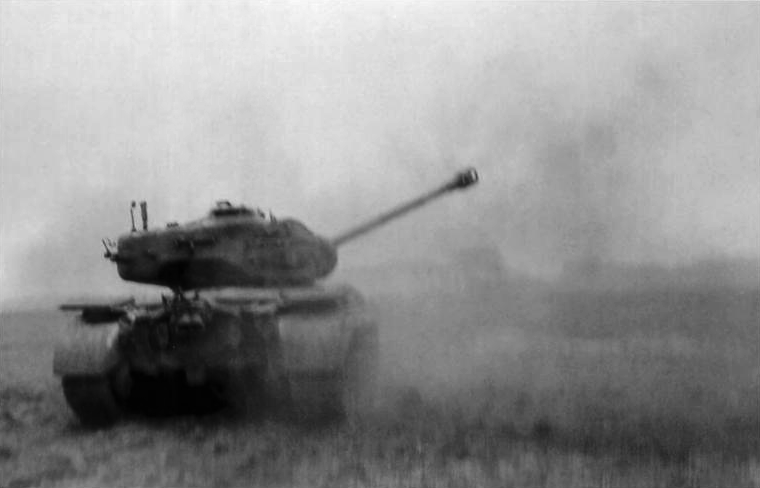
This bridge, constructed by Germany in 1918 to aid in the German military’s logistical need to move large numbers of troops and material to the Western Front, now stood between the Allied forces and the last natural barrier to crossing deep into Germany. Aware of the potential threat the bridge posed, Germany moved quickly to demolish it. General Hoge’s soldiers discovered it just before the Germans were able blow it up. Making the decision to cross, the Americans laid down cover with smoke and white phosphorus and started to attack. With American M26 Pershing tanks on the ramp, Germany manually detonated 60 demolition charges they had attached to the bridge, yet somehow the bridge survived.
With quick precision, American troops secured the western bank of the bridge and began working to disarm additional German demolitions. Experiencing constant enemy fire, Army engineers worked furiously to repair the bridge’s railway and planking to aid in tank crossings as well as build alternate crossings near the bridge site. By late afternoon, the Allies had crossed Ludendorff Bridge, secured the eastern bank, and crossed the last major natural obstacle in their quest to reach Berlin and put an end to the war in the European Theatre.
Over the next several days, the Army capitalized on its success. They continued work on alternate pontoon bridges while stabilizing and repairing the Ludendorff Bridge. The Germans persisted in attempts to hamper or halt their progress, targeting the floats on the pontoon bridges, conducting air raids, and launching V-2 rockets from the Netherlands. The Americans responded by installing anti-aircraft weapons to protect their expanding bridgehead. Finally, on March 17, Ludendorff Bridge succumbed and collapsed while soldiers from the 276th Engineer Combat Battalion and 1058th Engineer Port Construction and Repair Group were working on it. Ultimately, 28 soldiers died, with another 63 injured.
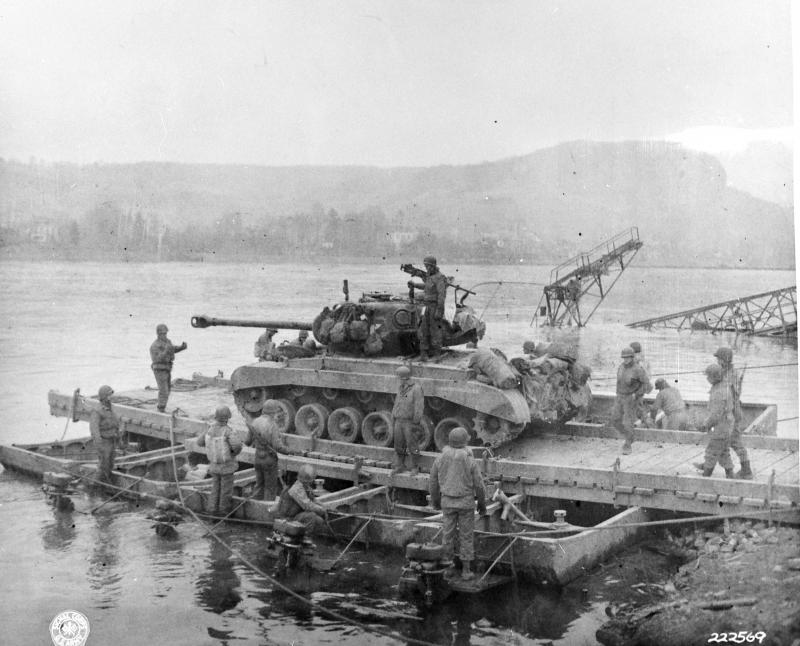
(National Archives/US Army)
Despite the loss of life, General Hoge and his soldiers took an unexpected opportunity and capitalized on it. For General Hoge, securing the Ludendorff Bridge was “probably the greatest turning point in [his] whole career as a soldier,” according to Hoge’s memoirs, which are maintained by the U.S. Army Corps of Engineers. The bravery of these soldiers and military engineers played an important part in the end of the war. Through their efforts, five American divisions were able to cross the Rhine as part of Operation: Plunder, the British-led push to cross the river and march on Berlin. By capturing the bridge, the U.S. Army significantly shortened this final drive across Germany, ensuring an end to the war weeks, if not months, sooner than would otherwise have been possible.
March 2025 marked the 80th anniversary of the Battle of Remagen. The Wright Museum is privileged to have one of the few Pershing tanks from this battle in its collection. According to institutional history compiled by our founder, David Wright, the museum’s Pershing was one of the first sent to Europe near the end of the war. Of those, three were present at the battle, and the museum’s is the only one of those three known to survive to this day. David rescued the tank from destruction on a testing range after somebody had discovered its lineage by looking up its serial number. David completely restored the tank to working order, and it is now one of the “stars” of the museum collection.
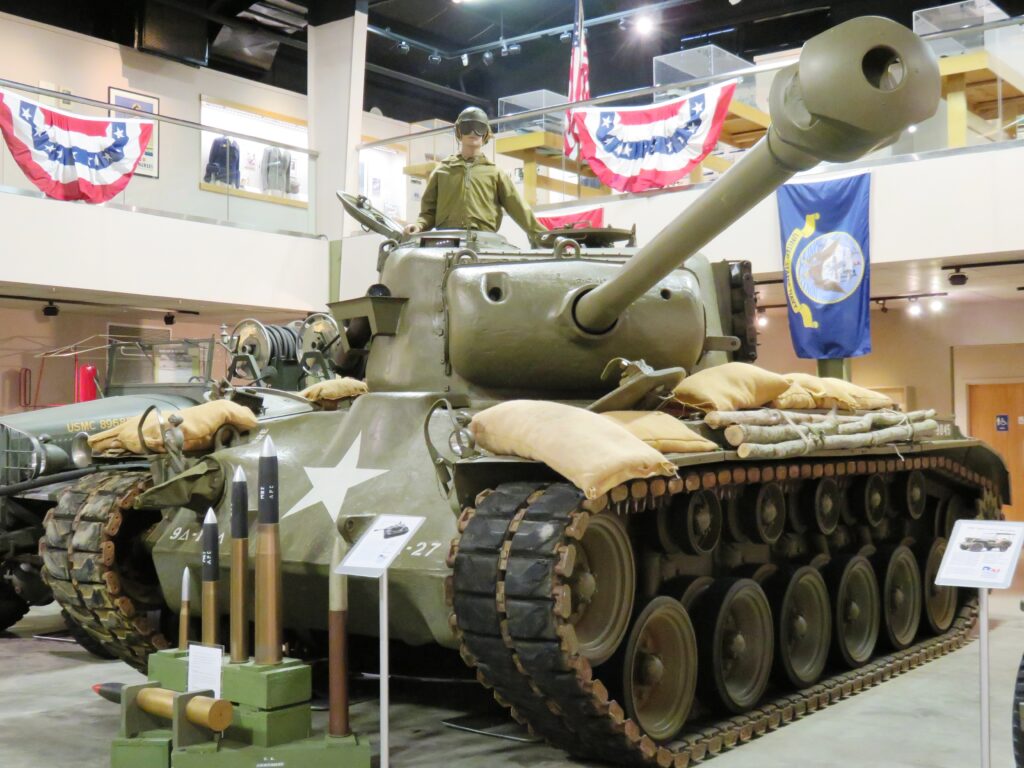
We invite you to come and explore our Military Gallery, which houses a rotating collection of the Museum’s vehicle collection, including tanks, half-tracks, jeeps, and motorcycles, in addition to uniforms and weaponry from World War II.
If you’re interested in learning more, check out these websites from which information for this article was obtained: “First Across the Rhine: The Bridge at Remagen” and “Battle of the Remagen Bridgehead.”
Featured Image
“First U.S. Army men and equipment pour across the Remagen Bridge; two knocked out jeeps in foreground. Germany.” March 11, 1945. National Archives photo 111-SC-201973. Photographs of American Military Activities. NAID: 531252. Unrestricted.