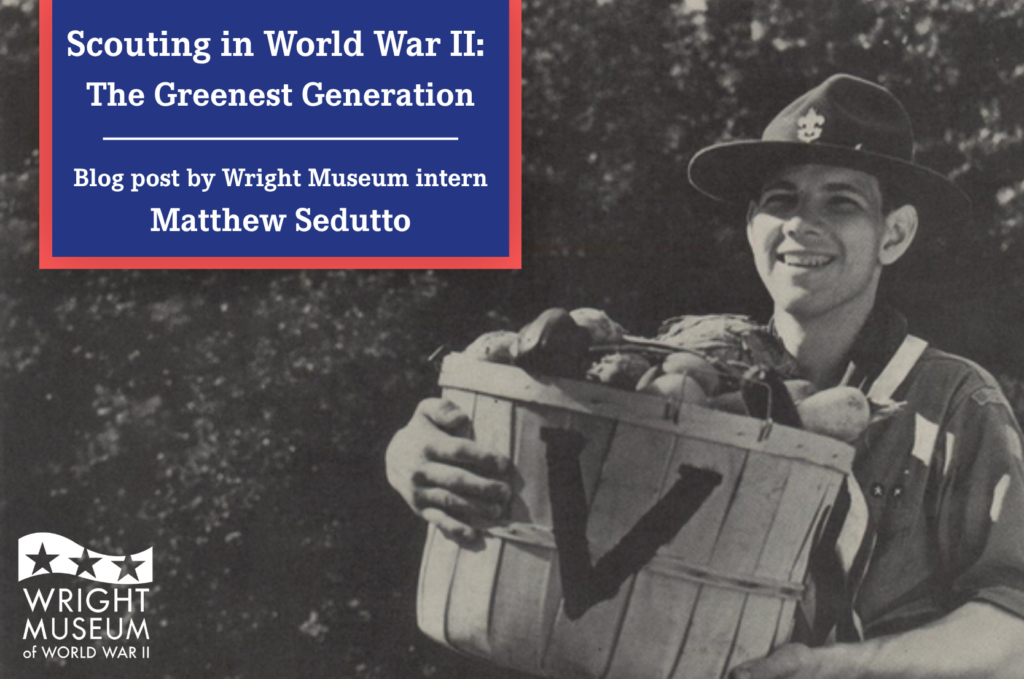
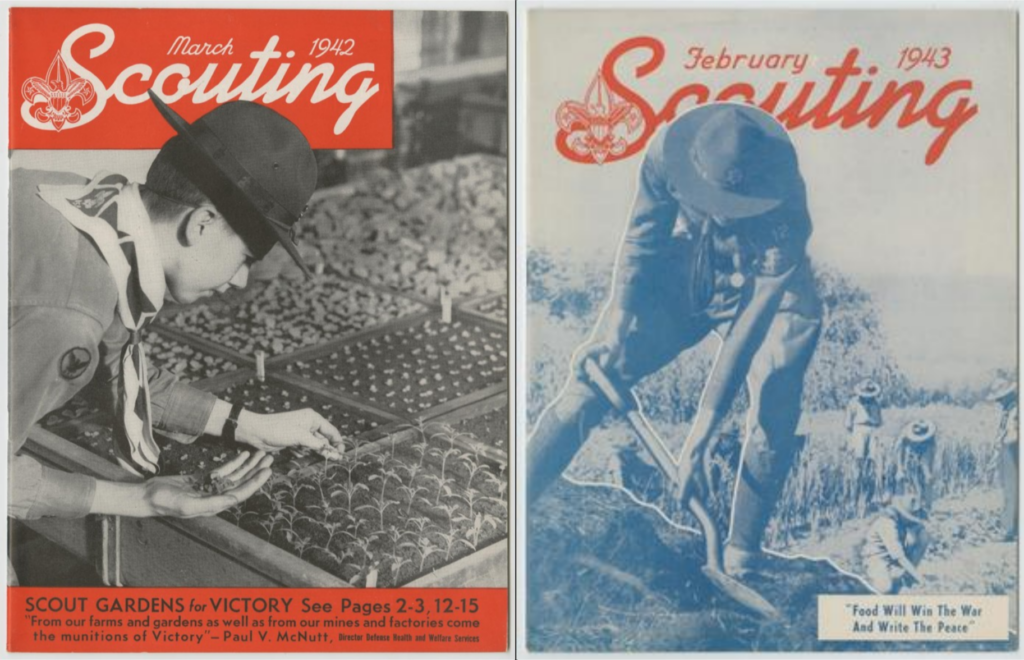
“From our farms and gardens, as well as from our mines and factories, come the munitions of victory.”
Paul V. McNutt, Director of Defense, Health, and Welfare Services.
Paul V. McNutt was quoted by Chief Scout Executive of the Boy Scouts of America, Dr. James E. West, in March of 1942, as the Scouts were called to grow gardens for victory! Gardening was one of many ways Americans contributed to the home front to support the war effort. Between 1942 and 1945, Scouts established more victory gardens than any other youth organization for the war effort, and they had the green thumbs to prove it.

Scouting
During the first half of the 20th century, Scouting was unlike any other program for young Americans. The Boys in khaki were deeply woven into the fabric of American society, which, at its peak, registered one in five boys as Scouts, totaling 1.5 million boys aged eleven to seventeen in Scout uniform.
Founded by retired British General Robert Baden-Powell, a decorated soldier from the Second Boer War, Scouting crossed the pond and entered the United States in 1910. The pillars of the Scouting program included outdoorsmanship, conservation, camping, service, discipline, self-reliance, leadership, and citizenship.
During World War II, Scouts’ pledge to their country became indisputable as they proved their worth on the American home front. Scouts collected books, paper, tin, rubber, and grease; they sold war bonds and stamps and distributed various publications. Scouts also served in the Emergency Service Corps and the Civil Defense, mainly as messengers. Finally, the Scouts’ outdoor skills contributed to their greenest impact, planting trees, growing victory gardens, and harvesting crops.
Victory Gardens
A mix of labor shortages combined with the need to feed American troops overseas encouraged Americans at home to harvest their own crops to support the war effort. Between 1941 and 1945, twenty million Americans answered the call to grow gardens. By 1944, Victory Gardens were estimated to account for 40% of the fresh fruits and vegetables consumed in the country.
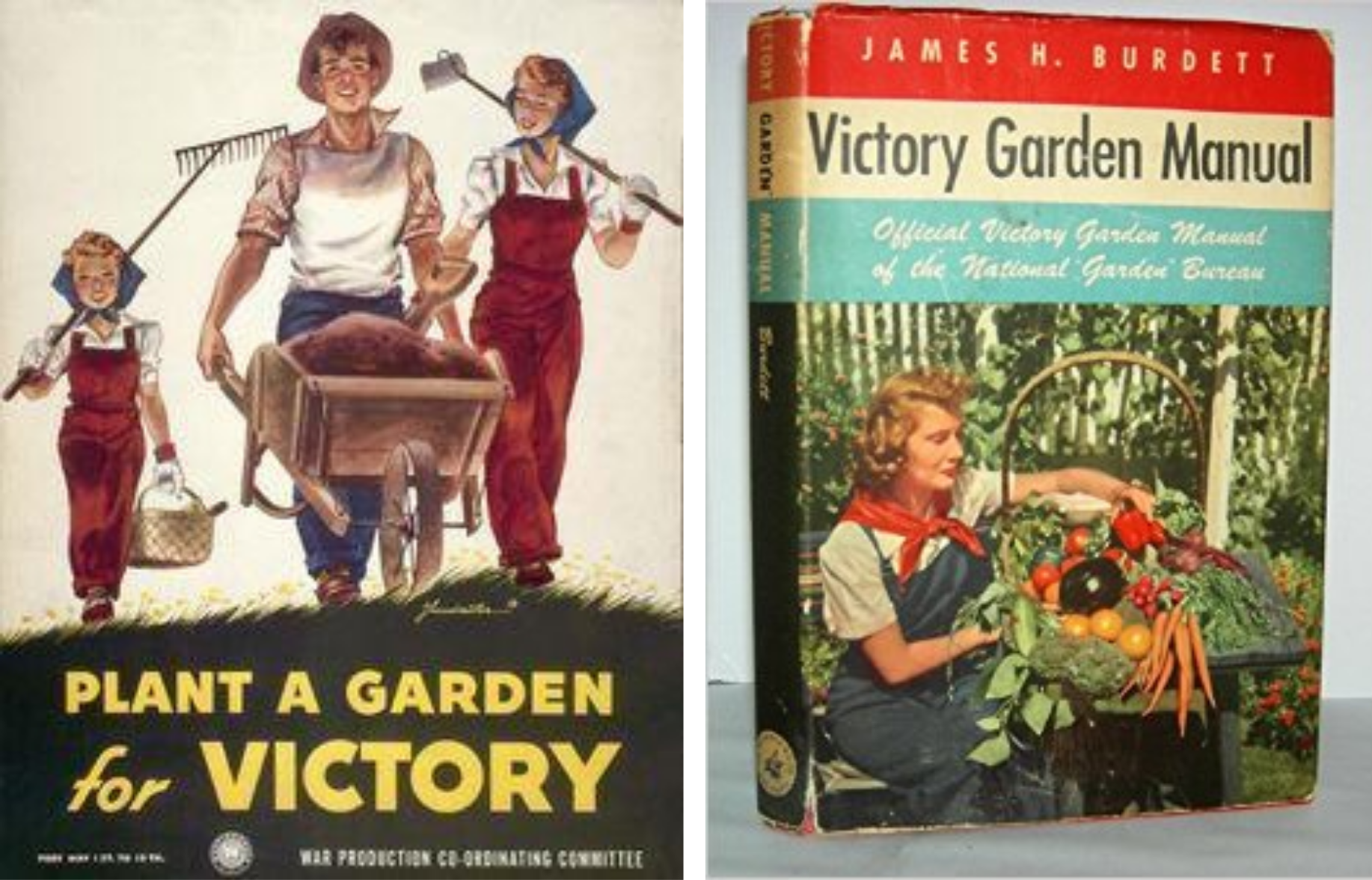
For Scouts, gardening was already an avenue of their adventure, with merit badges offered in gardening, agriculture, corn farming, fruit culture, citrus-fruit culture, nut culture, fruit and nut growing, forage crops, and soil management. The Scout leader’s monthly magazine mentioned gardens and the importance of growing them in nearly every issue during the war years. Furthermore, the National Scouting organization provided instruction on garden bed construction, planting guidance, seed timelines, and all the information a Scout or leader needed to encourage the entire Troop to dig into Victory Gardens.
Green Thumbs
Scouting was supported in its mission to promote gardening, with resources and guidance on Victory Gardens from the National Garden institute. Founded in 1920 by James H. Burdett, the institute aimed to address what Burdett considered a lack of suburban instruction in basic backyard gardening, following lessons learned from World War I.
The institute published manuals, resources, and books on gardening, supporting organizations with more manpower to grow them, such as the Scouts. Information was published in copies of Scouting and Boys’ Life magazines. Towards the end of the war, the institute created various awards to reward Scouts who had risen to the challenge of the wartime demands and contributed to the national gardening effort.
Additionally, Scouts in cities without access to plots for gardens found their way into the country, working to address manpower shortages. In Scouting magazine, the National Director of Rural Scouting, E. H. Bakken, called to mobilize half a million scouts to fit gardening into their unit program through activities such as a product hike, “when everyone brings for the ‘hunters’ stew’ something he has grown,” and publicize their gardening skills.
By the end of 1944, the Boy Scouts of America estimated that, after Pearl Harbor, 184,000 Victory Gardens had been grown, 126,000 city boys had worked on farms, and 1,500,000 trees had been planted by Scouts.
In April 1945, the institute created the short-lived “Green Thumb Certificate” to recognize and reward young Americans who had created Victory Gardens, which, in a few months, was replaced by the General MacArthur Gardening Award. The institute created the award, which was to be distributed and awarded by the Scouts and other youth organizations. Published in Scouting magazine in April and republished again in October of 1945, the national Scouting leadership reminded their leaders to submit award recommendations and to recognize their Scouts who, over the past five years, had grown Victory Gardens. Whether all the Scouts who had earned it received it is unlikely; nonetheless, 12,369 Scouts received the Green Thumb Certificate, and thousands more MacArthur awards were awarded between 1945 and 1946.

[Left image] Boy Scout exclusive award (top left), standard produced award (top right), and Scouting’s gardening related merit badges.
[Right Image] World War II Scout uniform with MacArthur Award (right), Eisenhower Award (left), War Service Patch (top), and Eagle Scout (bottom).
The MacArthur award had six criteria for a young American to earn it, which required substantial time, effort, and dedication to caring for a garden. The institute was looking for a garden the size of a two-car garage, well-maintained, with a variety of vegetables or fruits put to good use, and inspected by the local Scouting Council leadership so that a Scout, or sometimes an entire unit, could receive the award.
- At least 400 square feet in size.
- A reasonable variety of products
- Diligently cared for
- A good producer, based on local conditions
- Properly harvested with products put to good use
- Inspected and recommended by the Local Scouting Council
In total, the National Gardening institute would create 30,000 MacArthur awards, distributed to groups such as the YMCA, 4-H clubs, and other youth organizations. 20,000 of those awards would be sent directly to the Scouts. The other 10,000 made up all other youth organizations combined. When only considering the distribution of the MacArthur award, all other youth groups came close to half of the impact the Scouts had on homefront gardening.
This post was authored by Matthew Sedutto as part of a summer 2026 internship at the Wright Musuem.
Sources
- “About”– National Gardening Bureau
- “Victory Gardens” – US Composting Council
- Covers of “Scouting” magazine – The Portal of Texas History, SCOUT collection, Scouting Magazine, 1940-1949
- E. H. Bakken, “Half a million “Green Thumbs”” Boy Scouts of America, Scouting Magazine, April
- 1945, Lawrence L. Lee Scouting Museum & Max I. Silber Library, Manchester, New Hampshire, 2026, pg. 6.
- Reis, Mitch, “The Boy Scouts of America During World War I & II” Lawrence L. Lee Scouting
- Museum & Max I. Silber Library, Manchester, New Hampshire, 2026, pg. 19.
- “The Story of Scouting in 1944” Boy Scouts of America, Scouting Magazine, June 1945,
- Lawrence L. Lee Scouting Museum & Max I. Silber Library, Manchester, New Hampshire, 2026, pg. 5-6.
To learn more about the Wright Museum’s working Victory Garden exhibit, click here.