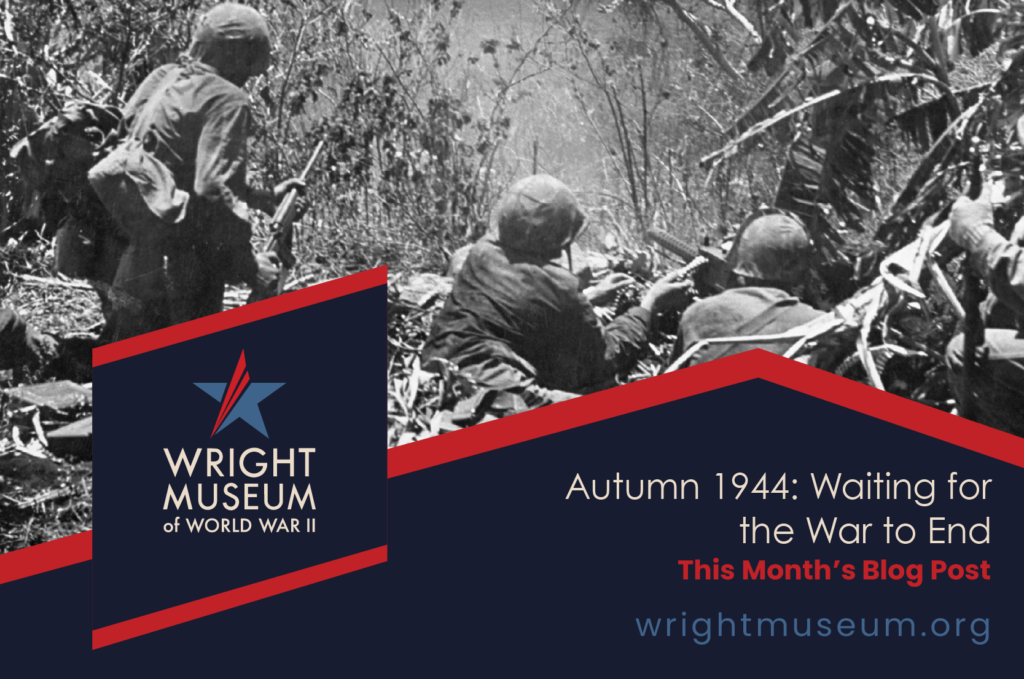
On the home front, Americans spent three months preparing for a peace that kept slipping away.
In late summer 1944, the United States Post Office told Americans to start thinking about Christmas. Both the Army and the Navy had set the same window for mailing gifts overseas: September 15 through October 15. As they stated, “the earlier the better.” Parcels could weigh no more than five pounds. No more than one package a week could go to the same serviceman from the same sender. Nothing perishable. Nothing in glass. And because the War and Navy Departments insisted that troops were “amply provided with food and clothing,” the public was urged not to send either.
So, Americans shopped early, packed hard candy and playing cards into shoebox-sized parcels, and stood in post office lines. By September 20, 1944, roughly 540,000 Christmas parcels had already been mailed overseas.
Many of the people mailing those boxes did not really expect them to be needed. The war looked nearly won.
The Autumn Everyone Thought Was the Last
It was not an unreasonable belief. Allied armies had broken out of Normandy, liberated Paris, and reached the German border in less time than it had taken to capture Caen and St. Lô. The speed of it convinced almost everyone that victory before winter was within reach. Allied intelligence concluded in late August that “organized resistance was unlikely to continue beyond 1 December 1944, and it may end even sooner.”
Washington began planning accordingly. On August 14, the War Production Board lifted controls on a range of household items and announced that after Germany’s defeat, munitions production could be cut by as much as 40 percent. Early in September, the first factories resumed making civilian goods under a plan built for exactly this moment. Vacuum cleaners, electric ranges, eggbeaters, and lawn mowers appeared on the list of things Americans might soon buy again.
By November, the War Production Board had reversed itself entirely. Munitions orders rose in November over October and increased again in December. The board’s chairman announced that “from now on we are assuming that the war will go on indefinitely.”
The reversal confirmed a worry the government had carried since early in the war. In June 1942, the Office of War Information (OWI) sent Hollywood studios its Government Information Manual for the Motion Picture Industry. The manual warned that “the mortal realities of war must be impressed vividly on every citizen.” Americans, the manual acknowledged, were irrepressibly cheerful and optimistic, but war meant death, suffering, and sorrow. The men in the service were given no illusions about the grimness of the business they were in. And the manual argued that civilians owed them the same honesty: “We owe it to them to rid ourselves of any false notion we may have about the nature of war.” Two years later, in an autumn when Americans were eyeing new vacuum cleaners and mailing Christmas parcels they doubted would be needed, the warning had lost none of its force.
Ration Books and Reversals
For a few weeks in the autumn of 1944, rationing loosened. On September 17, after a good harvest, the Office of Price Administration (OPA) removed all processed foods except canned fruit from the ration list. Canned vegetables, soups, and juices that had cost blue stamps since March 1943 could suddenly be bought with cash alone.
The reasoning was straightforward, and the OPA later stated it plainly. In September 1944, it seemed possible that the European war might end within a few months, so with military and lend-lease requirements expected to fall off, foods came off the ration list and point values dropped. Some historians have suggested the timing was tied to the presidential election, but primary sources do not support the claim.
Then the war did not end, and the reversal came hard. In late December the OPA returned five vegetables to the ration list and restored most unrationed meat, raising the share of civilian meat requiring points from 37 to 85 percent. On January 1, 1945, processed foods went back on points entirely, a direct consequence of the fighting in the Ardennes.
The projections for the coming year told Americans what the delay would cost them at the table: about 14 percent less meat in 1945, 33 percent less canned vegetables, 25 percent less canned fruit, and 12 percent less sugar.
Other shortages had never eased at all. Shoe rationing, in place since February 1943, had been cut from three pairs per person a year to two. The basic “A” gasoline coupon was down to about two gallons a week, which ended most pleasure driving. Civilian fuel oil ran roughly 18 percent below 1942 levels, a serious matter in New Hampshire, which the OPA placed in its coldest heating zone alongside Maine, Vermont, and northern New York.
Cigarettes became the season’s most visible frustration. Roughly 30 percent of all cigarettes produced went to servicemen, leaving civilian counters bare. When the House Agricultural Committee opened an inquiry, it found an 18-month supply of cigarette tobacco sitting inside the United States. The shortage was not a shortage of tobacco. It was a shortage of a country able to get it where it was going.
Victory Gardens and Canning Kitchens
Whatever the ration board allowed, a great deal of what Americans ate in 1944 came out of their own backyards. Roughly 20 million victory gardens were producing something close to 40 percent of the fresh vegetables consumed in the United States.
The scale of that work is hard to overstate. In 1943, 75 percent of American homemakers put up 4.1 billion containers of food, an average of 165 jars each. They preserved another 3.5 billion quarts in 1944, nearly half of all the canned vegetables and two thirds of the canned fruits available to civilians.
None of it was simple. Pressure canners were made of aluminum, so the government had halted their production and rationed the existing supply. Families without one borrowed from neighbors or carried their harvest to a community cannery, and by the end of the war more than 3,800 of those canneries were operating nationwide, many in school basements and church kitchens. Canners could apply for up to 20 extra pounds of sugar, though the sugar was not guaranteed.
Here, too, the autumn brought a reversal. Because rationing had eased earlier in the year, the government put less emphasis on gardening and home preservation, and when shortages returned officials had to restart the campaign. The equipment numbers tell the story. The War Production Board capped pressure canner production at 40,000 units for 1944. For 1945, it raised the cap to 630,000.
There was one more wartime habit that worried the government, and it was the opposite of waste. Families were so proud of their filled shelves, and so uncertain about what the coming year held, that many of them would not open the jars. There were two mistakes to avoid, Good Housekeeping warned: serving favorites too often and using your supply so sparingly that you would have some left over when the summer’s garden crop came along.
Rosie’s Last Full Autumn
Women’s wartime employment reached its peak in July 1944, with roughly 19 million women at work, an increase of about 47 percent over March 1940. Manufacturing absorbed much of that growth, climbing from 21 percent of female employment in 1940 to 34 percent by March 1944. Unemployment nationwide fell to 1.2 percent, an all-time low.
The popular image of that workforce needs one correction. Most of the women employed in March 1944 had already been working before Pearl Harbor, with another 13 percent entering the labor force during the war years. Many wartime “Rosies” had not left a kitchen for a factory. They had left a laundry, a shop counter, or a domestic service job for better pay.
Which is why the approaching peace looked different from the factory floor than it did from the front page. In the summer of 1944, the United Auto Workers (UAW) surveyed its female members and found that 85.5 percent wanted to keep their jobs after the war. A Women’s Bureau study of ten war production areas found that about 75 percent of wartime employed women planned to stay in the labor force, and that 86 percent wanted work in the same industry. These were the largest such surveys of the period, though others taken at the time disagree.
Their reasons were not sentimental. Of the women who planned to keep working, 84 percent said they had no alternative because they were supporting themselves or supporting others as well. Only 8 percent said they would stay because they liked the work or liked having their own money.
The war had also been physically costly at home in ways that rarely made the news. Between Pearl Harbor and D-Day, American industrial casualties on the home front exceeded American military casualties.
So, in the autumn of 1944, millions of women were doing two contradictory things at once. They were buying war bonds and mailing Christmas parcels to hasten the end of the war, and they were reading the same reconversion announcements the newspapers celebrated and wondering what those meant for a paycheck they could not afford to lose.
Portsmouth Naval Shipyard
The war that felt nearly over in September was still being built on the Piscataqua River. Portsmouth Naval Shipyard had averaged fewer than two submarines a year in the 1930s. In 1944 it completed thirty-one, a record for a single calendar year, and cut its construction time per boat from 469 days in 1941 to 173 days. On January 27 of that year, four submarines slid into the water in a single day, a record that still stands.
That pace did not slacken in the autumn. The Argonaut was launched on October 1 and the Cutlass on November 5. The Sennet finished fitting out on September 18, spent a month testing torpedo tubes off the New England coast, and reached Pearl Harbor on December 16, the same day the Germans attacked in the Ardennes.
Building these submarines took a workforce the region had never seen. At its peak, more than 20,000 civilian workers poured into the yard each day. Women worked as welders, riveters, and inspectors, in cramped submarine compartments and on open scaffolding through New England winters.
The strain fell on nearby towns. The population surge stretched housing, roads, and public services, leaving workers arriving from across northern New England with few clear places to stay. One result was almost welcome: With gasoline rationing making long trips impossible and thousands of workers and servicemen clustered around the yard, Hampton Beach became New England’s convenient wartime getaway.
But the question underneath the autumn of 1944 in Portsmouth was the same one being asked in every war plant in the country, and it was not a happy one. Local communities had built their prosperity on submarine construction, and they feared a disastrous postwar future if peace brought sharply reduced employment or closure of the yard.
The yard was working at a speed it had never achieved and would never achieve again, launching boats that would not reach the Pacific until the following year, while the people building them hoped for an ending that would put many of them out of work.
Bonds, Ballots, and Blueprints
The Toughest Drive
The Treasury opened the Sixth War Loan on November 20 with a goal of $14 billion, $5 billion of it assigned to individual buyers. “It will be the toughest war loan campaign to put over,” The Exhibitor told theater owners, and the reason was not hard to identify. Confidence that the war was nearly won had made saving feel less urgent than spending.
Treasury officials said so almost openly, aiming the drive squarely at what one newspaper called “the easy money now outstanding and reflected in so-called luxury spending.” Six million “Victory Volunteer” workers went out to sell it, working quotas divided by state, then county, then town, so that a place like Tuscola County, Michigan knew it owed $1,180,000.
Americans bought anyway. By the drive’s close on December 16, it had raised $21.6 billion, well past its goal.
The Fourth Term
On November 7, Franklin Roosevelt defeated Governor Thomas E. Dewey of New York and won an unprecedented fourth term, 432 electoral votes to 99. New Hampshire’s four electoral votes went to Roosevelt, while Maine and Vermont went to Dewey.
It was the only presidential election the United States held while fully at war, and the war shaped how it was conducted. Congress had passed a soldier voting bill in April 1944, encouraging states to amend their absentee procedures or adopt an Official Federal War Ballot, and twenty states authorized it. New Hampshire was among them, though it permitted servicemen to use the ballot only for presidential electors.
The results reveal the gap between the two Americas of that autumn. About 56 percent of eligible civilians voted. Among the roughly 9.2 million service members of voting age, only about a quarter cast a ballot.
Ninety Percent of a Peace
Meanwhile, in a Georgetown mansion, diplomats spent the late summer and early autumn designing the institution meant to prevent the next war. The Dumbarton Oaks Conversations ran from August 21 to October 7 and produced the framework of the United Nations, released to the public at noon on October 9.
Roosevelt described the agreement as roughly 90 percent complete. The largest question was how voting in the Security Council would work, which is to say whether the great powers could veto action against themselves. E.B. White was unimpressed by the arithmetic. “That of course isn’t ten per cent,” he wrote. “It is about 99.44 per cent.”
So, the autumn of 1944 asked American civilians to do three things at once: finance a war that was supposed to be ending, choose a government to finish it, and imagine the machinery of a peace whose hardest question nobody had answered yet.
Movies and Music
Americans went to the movies. Box office receipts had climbed from $740 million in 1940 to $1.34 billion in 1944, and a Gallup study that April put weekly paid attendance at about 62 million, with another 10 million servicemen a week watching in military theaters.
What audiences chose in the autumn of 1944 is telling. Meet Me in St. Louis premiered in St. Louis on November 22, and MGM held its general release for Christmas. It became the fifth highest grossing film of the year. The picture features a turn-of-the-century family that considers moving away and then decides to stay together, very nearly the opposite of what the war had done to American households.
A considerably darker version of the song “Have Yourself a Merry Little Christmas” was written for the film, suggesting that this Christmas might be the last good one and that friends who had been dear would not be near again. Judy Garland and others pushed back, and songwriter Hugh Martin revised the lyrics into something hopeful about next year’s troubles being out of sight. The bleaker version was closer to the truth, and nobody wanted to hear it.
Radio carried the rest. Bing Crosby’s “White Christmas” and “I’ll Be Home for Christmas,” the latter structured as a serviceman’s letter that ends by admitting the homecoming may only happen in a dream, had already found an audience that understood exactly what was being described.
Major Glenn Miller, whose band General James Doolittle called the greatest morale-builder in the European theater, boarded a small plane in Bedfordshire on the afternoon of December 15, bound for Paris. The plane never reached France. The Allies did not realize he was missing for several days because the following morning the Germans attacked in the Ardennes. The public learned about it on Christmas Eve.
A Turkey Nobody Could Buy
Roosevelt proclaimed Thursday, November 23 a day of national thanksgiving, and asked Americans to observe it “by bending every effort to hasten the day of final victory.”
They observed it without turkey. The 1944 crop was excellent, but the War Food Administration had determined there were only enough birds to meet military demand, so turkeys stayed under embargo for civilians. The Army and Navy had decided that every soldier and sailor, at home and abroad, was going to have turkey for the holidays, and a set-aside order guaranteed it. Cranberries were the same. Servicemen would have more of them than in 1943. Civilians would have fewer.
Gourmet magazine put the civilian arithmetic plainly that November: a quarter pound less turkey per person than the previous winter, when it had been three pounds apiece. “This year it will be half a drumstick less for the plate. But listen where the missing bit’s going.”
Where it was going was the Great Republic, which sailed from New York on October 15 carrying 1,604 tons of frozen turkey and reached Le Havre on November 16, enough for a million meals. Some units did not eat until a day or two after the holiday, but nearly every American soldier in Europe got the meal.
At home, the shortage produced exactly what shortages produce. Turkey had never been rationed, but the scale of the military purchase emptied the counters, and black market operations proliferated. On November 22, police raided one in Brooklyn.
Thanksgiving 1944 was a sober, somber holiday. Few Americans traveled to see relatives because gasoline rationing made driving impractical and train seats were needed for troops. The most conspicuous absence at the table was not the bird. It was the empty chair, made harder to look at by a summer of announcements suggesting the war should have been over by Thanksgiving.
In the German Hürtgen Forest, U.S. Lieutenant Paul Boesch was promised a hot turkey dinner for his men. The turkey arrived, along with cranberry sauce and a cigar for each man. Then a German barrage came down, and many of Boesch’s men were killed or badly wounded.
By December 31, all meats went back on the ration list. The liberated countries needed feeding, the war had not ended, and the American table was asked to give back what it had briefly been allowed to keep.
The Other Side of Waiting
There was a place where waiting for the war to end meant something else entirely, and it was the country the Allies had just failed to liberate.
When the Dutch government in exile called a railway strike on September 17 to support Operation Market Garden, some 30,000 railway workers walked off the job. The Germans retaliated by blocking food transports to North and South Holland, and the supply never recovered. Roughly 4.3 million people in the western provinces were cut off. Rationed food had provided about 1,400 calories a day per person in September; by November 26, the system was delivering 750. Gas and electricity were shut off. City dwellers walked into the countryside trading jewelry and linen for a few potatoes, and soup kitchens served rations made from sugar beets, tulip bulbs, and potato peels. At least 20,000 people died, most of them elderly.
This reality of the war in Europe is worth holding alongside the American autumn. In the United States, the failure at Arnhem meant that rationing would tighten again and the Christmas packages had been mailed for nothing. In the Netherlands, it meant a winter of eating tulip bulbs. Both were the cost of a war that would not end on schedule. They were not the same cost.
Peace Postponed
By the end of November, the evidence still pointed in one direction. Aachen had fallen on October 21, the first major German city taken by the Allies. MacArthur had waded ashore at Leyte and told the Philippines he had returned. B-29s were flying against Tokyo from Saipan. Roosevelt had a fourth term, the Sixth War Loan had blown past its goal, and diplomats had drafted the charter of an organization meant to make all this unnecessary in the future.
And then on December 16, the Germans attacked through the Ardennes, the War Production Board announced it was now assuming the war would go on indefinitely, and on the last day of the year all meats went back on the rations list.
The Christmas packages mailed in September had arrived by then or had not. Some reached men who were no longer where the address said they were; some were opened in foxholes in the Ardennes, or in prisoner of war camps, or in field hospitals; some returned home unopened. The families who had wrapped them in the warm weeks of early autumn spent the winter learning that the war had a good deal more of itself left to spend.
Autumn 1944 was not the season the war ended. It was the season Americans found out that knowing you will win and knowing when are two entirely different things and that the distance between them is measured in ration stamps, empty chairs, and letters that take a very long time to answer.
Here at the Wright Museum, we tell not just the stories of the men and women on the front lines but also the equally compelling stories of those who tended the home front. Join us at the Museum from May 1 to October 31 to learn more about how the lessons of World War II continue to shape our country in profound and lasting ways.
Sources for “Autumn 1944: Waiting for the War to End”
Opening: Christmas Mail
- United States Post Office Department, Postal Bulletin, June 2, 1944
- Virginia Chronicle, “Overseas Christmas Package Mail Rules,” August 18, 1944
- The New York Times, “Gifts Going to Troops; 540,000 Yuletide Packages Mailed Abroad Thus Far,” September 20, 1944
Expectations and War Production
- U.S. Army Center of Military History, The Supreme Command, Chapter XIV: “The Pursuit Stops Short of the Rhine”
- Federal Reserve Bulletin, September 1944
- U.S. Government, War Production in 1944: Report of the Chairman of the War Production Board
- The New York Times, “Hundreds of Items Get WPB Release,” August 15, 1944
- National Archives, “He Knew the Meaning of Sacrifice,” Powers of Persuasion
Rationing and Shortages
- Office of Price Administration, “Food Rationing Changed to Meet 1945 Needs”
- National Park Service, “Food Rationing on the World War II Home Front”
- National Park Service, “Meat Rationing on the World War II Home Front”
- National Park Service, “Rationing of Non-Food Items on the World War II Home Front”
- U.S. Government, Rationing in World War II
- The Great Plains During World War II, “Rationing”
- Bates College Muskie Archives, “Gas and Fuel Oil Rationing”
- Armed Forces Journal, “1944: Smoke ’em if you…never mind”
Victory Gardens and Canning
- National Park Service, “Canning and Food Preservation on the World War II Home Front”
- USDA National Agricultural Library, “Canning Through the World Wars”
- USDA National Agricultural Library, “Victory Gardens and Farms”
Women and War Work
- U.S. Women’s Bureau, Changes in Women’s Employment During the War, June 1944
- U.S. Women’s Bureau, Women Workers in Ten War Production Areas and Their Postwar Employment Plans
- Center for History and New Media, “’Continued Employment after the War?’: The Women’s Bureau Studies Postwar Plans of Women Workers”
- National Park Service, “The WWII Home Front”
- Evan K. Rose, “The Rise and Fall of Female Labor Force Participation During World War II in the United States,” Journal of Economic History
Portsmouth and New Hampshire
- Naval Sea Systems Command, “Portsmouth Naval Shipyard: 20th Century History”
- Wright Museum of World War II, “From Powder, Planks, and Periscopes: New Hampshire’s WWII Shipyard Powerhouse”
- Wright Museum of World War II, “From Sails to Atoms: The Portsmouth Naval Shipyard”
- Rodney K. Watterson, “32 in ’44: A Management and Environmental Study of Submarine Construction at Portsmouth Navy Yard During World War II,” University of New Hampshire
- Peter E. Randall, Hampton: A Century of Town and Beach, 1888-1988, “World War II”
- Naval History and Heritage Command, “Sennet (SS-408)”
- Naval History and Heritage Command, “Segundo (SS-398)”
- NavSource Naval History, “Thornback (SS-418)”
Bonds, Ballots, and Peace Plans
- The Exhibitor, November 1944, Sixth War Loan coverage
- Duke University Libraries, Ad*Access Research Guide: Loans and Bonds
- The American Presidency Project, “1944 Presidential Election”
- National Archives, “1944 Electoral College Results”
- The National WWII Museum, “The Soldier Voting Act and Absentee Ballots in World War II”
- Dumbarton Oaks, “Dumbarton Oaks Conversations”
- U.S. Department of State, Foreign Relations of the United States, 1944, General, Volume I
Movies, Music, and Waiting
- St. Louis Public Radio, “70 Years Ago: The World Premiere of ‘Meet Me in St. Louis’”
- EBSCO Research Starter, “Meet Me in St. Louis (film)”
- National Archives, “Remembering Major Alton ‘Glenn’ Miller (1904–1944)”
- The National WWII Museum, “Major Glenn Miller: The Loss of an Icon”
- National Archives, Boy Scout waste-paper drive materials
Thanksgiving 1944
- Franklin D. Roosevelt, “Thanksgiving Day, 1944: A Proclamation”
- Airborne Museum, “Thanksgiving 1944”
- Friends of the National World War II Memorial, “Thanksgiving 1944”
- Task & Purpose, “How a Single Ship Made Thanksgiving Happen in Europe at the Height of WWII”
- National Park Service, “Meat Rationing on the World War II Home Front”
The Dutch Hunger Winter
- Dutch Resistance Museum, “The Hunger Winter”
- Anne Frank House, “Hunger Winter: Hunger and Cold in the Netherlands”
- National Library of Medicine, “Famine Food of Vegetal Origin Consumed in the Netherlands During World War II”
Military Milestones Mentioned in the Conclusion
- U.S. Army Center of Military History, “Rhineland”
- EBSCO Research Starter, “General Douglas MacArthur Returns to the Philippines”
- Australian Department of Veterans’ Affairs, “Remembering the Largest Naval Battle of the Second World War”
- National Museum of the U.S. Air Force, “Development of the Boeing B-29”