Shipyard Powerhouse
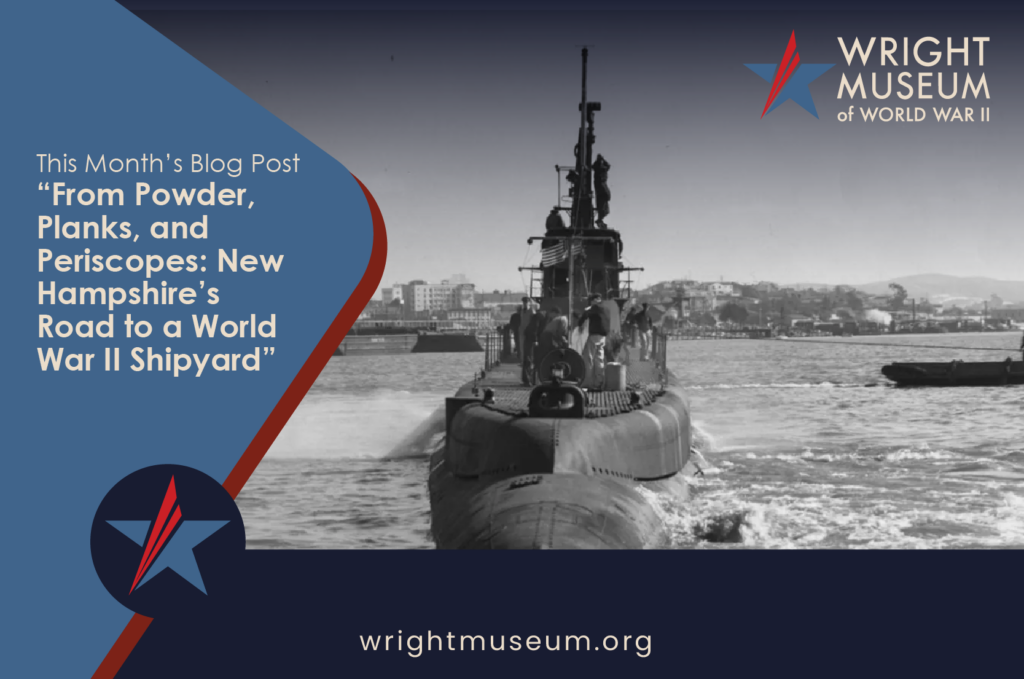
On a cold January morning in 1944, the quiet along the Piscataqua River shattered with the sound of whistles, hammers, and cheering. At Portsmouth Naval Shipyard, thousands of workers crowded the yard as not one but four submarines slid into the water in a single day. Welders who had worked through the night leaned on railings to watch their handiwork float free. Families pointed and waved at the gray hulls, knowing that before long those boats would be heading for distant oceans and dangerous patrols. For a brief moment, the war felt both far away and very close: far away in miles but close in the sweat, skill, and speed that made that record-setting launch possible.
Here in New Hampshire, the sight of submarines in Portsmouth Harbor during World War II did not appear out of nowhere. It was the latest chapter in a much older story that began with barrels of stolen gunpowder and wooden sailing ships, passed through age-of-sail warships and Civil War repairs, and eventually arrived at an all-out industrial effort to build the undersea fleet that helped win the war. At the Wright Museum of World War II, we see Portsmouth Naval Shipyard as a perfect example of how a relatively small New England community helped shape events on a global scale.
Powder and Patriotism: New Hampshire in the American Revolution
Long before the submarines prowled the depths, New Hampshire’s coast mattered for a simpler reason: It was where ships, cargo, and gunpowder entered and left the colonies. Just inside the mouth of the harbor, British authorities manned Fort William and Mary, a modest garrison guarding the anchorage. In December 1774, months before Lexington and Concord, that outpost briefly became one of the most important places in North America.
Alarmed by British plans to tighten control over colonial powder stores, New Hampshire patriots, alerted by riders like Paul Revere, raided the fort over two days. They seized cannons, muskets, and barrels of powder and spirited them away into the countryside. Some of that gunpowder would later help feed the guns around Boston. New Hampshire would go on to adopt the first written state constitution in the former colonies in early 1776, underscoring just how committed this small province was to independence.
For the new United States, Portsmouth’s shipyards and harbor facilities formed part of the young republic’s maritime backbone. The same sheltered waters that had once seen British supply ships now served as a nursery for American seamanship and naval support. That early experience managing harbors, fortifications, and shipbuilding helped New England communities understand that control of the sea lanes was not an abstract concern; it was a question of survival.
From Timber to Steam: A Growing Navy Yard
The federal government established what became Portsmouth Naval Shipyard in 1800, on the Kittery, Maine, side of the river, to serve a growing U.S. Navy. Its first major accomplishment came in the War of 1812 era, when shipwrights built USS Washington, a 74-gun ship. Constructing such a large wooden warship demanded impressive amounts of timber, labor, and know-how, and it cemented the yard’s role as a place where the United States could build serious sea power close to home.
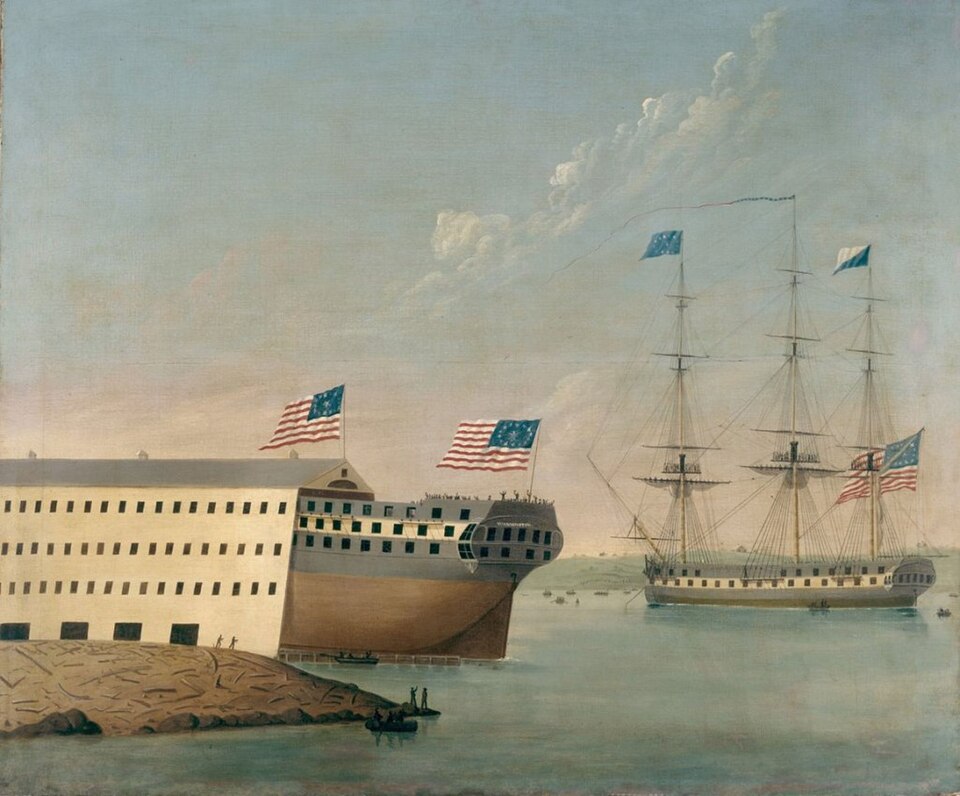
Throughout the 19th century, the yard repaired and constructed ships as sail gave way to steam and wooden hulls slowly yielded to iron and steel. During the Civil War, Portsmouth supported the Union fleet by refitting vessels and keeping them in fighting shape for blockade duty and blue-water operations. The same Piscataqua shores that had once seen small privateers now helped sustain one of the most important naval campaigns of the war: the maritime pressure that tightened around the Confederacy.
By the early 20th century, Portsmouth Naval Shipyard had taken on another, quieter role. In 1905, its facilities and nearby naval buildings hosted part of the negotiations that produced the Treaty of Portsmouth, ending the Russo-Japanese War. President Theodore Roosevelt would earn the Nobel Peace Prize in part for shepherding those talks. For a brief moment in time, diplomats and journalists from around the world converged on this corner of New England, proof that Portsmouth’s maritime infrastructure had grown into a site of international significance.
Learning to Think Underwater
World War I pushed the yard in a new direction: under the surface of the sea. As German U-boats terrorized shipping in the Atlantic, the United States scrambled to expand its own submarine fleet. At Portsmouth, that meant taking familiar skills like precision woodworking, metal shaping, and pipe fitting and applying them to a very different kind of hull.
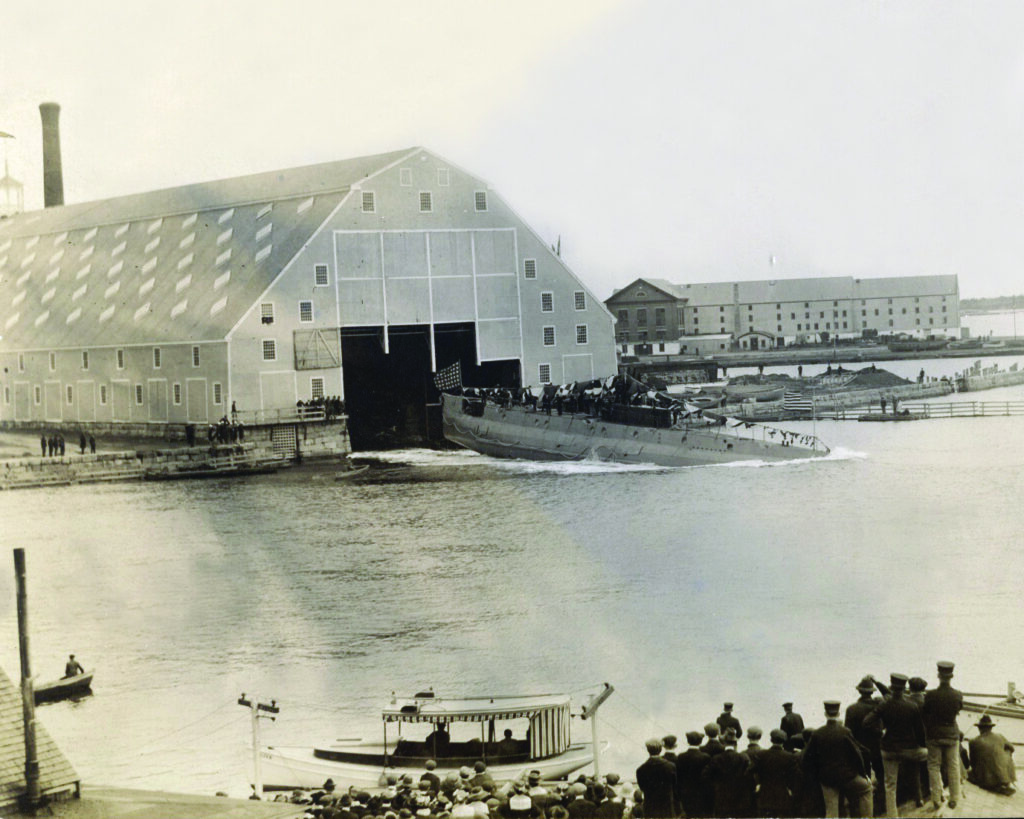
In 1917, the yard launched USS L-8, the first submarine ever built at a U.S. Navy yard. That milestone might have seemed modest at the time, but it forced the shipyard to develop specialized trades: machinists working in tight pressure hulls, electricians wiring batteries and control panels, and designers thinking in three dimensions about how to fit engines, bunks, torpedoes, and ballast tanks into cramped spaces. Those lessons would prove invaluable when the world plunged into another, even more devastating conflict a generation later.
“We Did It Here”: Portsmouth in World War II
When the United States entered World War II after Pearl Harbor, Portsmouth Naval Shipyard transformed almost overnight. In the 1930s, the yard had struggled through lean years, with limited projects and a relatively small workforce. By the early 1940s, it was a round-the-clock operation dominated by submarine construction, repair, and modernization. At its peak, more than 20,000 civilian workers poured into the yard each day. The population spike strained local housing, roads, and services, but it also knit the region into a single home-front community focused on one mission: getting boats to sea.
During the war, Portsmouth built dozens of submarines. Fleet boats that would prowl the Pacific, stalking Japanese shipping, and others assigned to training or Atlantic duty were all built at Portsmouth. Launching a submarine was only one part of the story. Inside the yard, designers refined hull forms, improved habitability, and experimented with new equipment based on feedback from the front. Outside the gates, families adjusted to irregular shifts, blackout conditions, and the constant knowledge that the quiet worker next to them might have a son or brother that would serve on the very boat they were building.
The four-submarine launch day on January 27, 1944, symbolized what the yard had become. Shipwrights and welders had to coordinate not just one complex project but four separate submarines, each with its own schedule, complications, and last-minute fixes. Cranes swung, inspectors signed off, and christening ceremonies overlapped as hull numbers slid down the greased way in quick succession. Newspapers and newsreels celebrated the achievement, but for the people on the ground it was further proof that they could make nearly impossible possible.
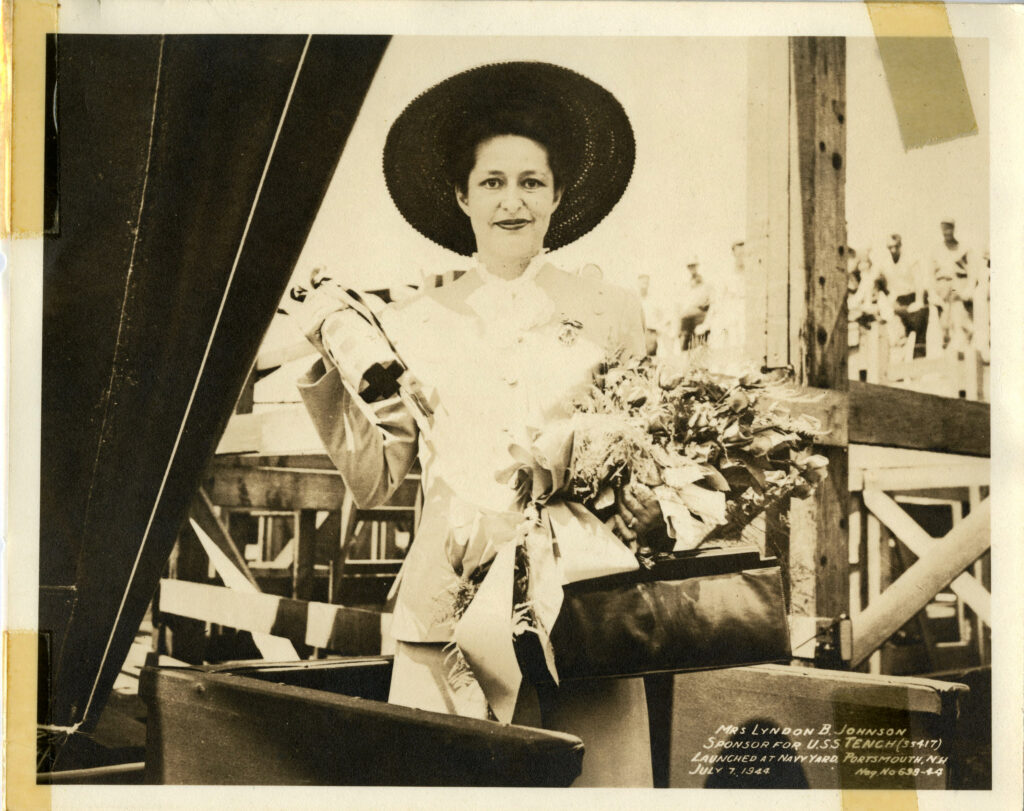
Behind those statistics lay countless personal stories. Women, who had often been excluded from skilled trades before the war, trained as welders, riveters, and inspectors, learning to work in claustrophobic compartments and on exposed scaffolding in all kinds of weather. Older craftsmen, more familiar with the tempo of peacetime repairs, found themselves mentoring younger coworkers who had never known a world without economic depression or war. Engineers who might once have spent their careers sketching modest refits suddenly found themselves wrestling with new sonar sets, radar antennas, and improved torpedo handling systems, all under relentless pressure to deliver.
The submarines that left Portsmouth’s waterways made their presence felt far from New England. Boats of the types built and refined here helped strangle Japan’s merchant fleet, cutting off fuel and raw materials. Others served as training platforms, preparing new crews for undersea warfare. Some never came home, lost with all hands in battles thousands of miles from the Piscataqua River. The sacrifice of those crews underscored the stakes of the work done in the yard. Every welding bead, every tested valve, every carefully aligned shaft could mean the difference between a successful patrol and a tragedy.
As the war drew to a close, Portsmouth’s waterfront offered an unfamiliar sight: surrendered German U-boats being towed into the harbor. For Portsmouth locals, seeing enemy submarines up close drove home how far-reaching the conflict had been and how thoroughly it had turned the Atlantic into a battleground. Some of those captured boats would be studied, used for trials, or scrapped. Another, U-505, spent years tied up at Portsmouth after the war before following her own unexpected path to survival as a museum ship in Chicago. Even in the war’s aftermath, the Navy continued to rely on the shipyard’s expertise to evaluate former enemy technology and plan for a new era of undersea warfare.
From Wartime Yard to Lasting Legacy
By 1945, Portsmouth Naval Shipyard had become one of the Navy’s premier submarine facilities, a status it would carry into the Cold War and beyond. The wooden ships and powder barrels of the Revolutionary era were long gone, but their legacy remained in the region’s deep familiarity with the sea and long tradition of maritime labor. The same river that had once seen patriots haul away stolen cannons now reflected the steel hulls of submarines designed to operate for months at a time beneath distant oceans.
Today, when we talk about New Hampshire’s role in American history, it can be tempting to focus on familiar scenes: town meetings, colonial taverns, and mountain landscapes. At the Wright Museum of World War II, we aim to broaden that picture. New Hampshire’s coastal communities and Portsmouth Naval Shipyard helped carry the nation from its earliest struggles for independence through industrialization and into a global conflict where undersea warfare played a decisive role.
Our current exhibit, From Sails to Atoms: The Portsmouth Naval Shipyard, invites visitors to explore that full arc: from early naval construction through the frantic World War II build-up and into the nuclear age. Along the way, you can step into a recreated submarine compartment, examine artifacts from the yard’s wartime boom, and learn more about the workers and sailors who made “We did it here” more than just a slogan. We invite you to visit during our 2026 season and see how a shipyard on the New Hampshire coast helped shape the outcome of World War II and the world we live in today.
Core Sources and Further Reading:
“Capture of Fort William and Mary, 1774,” American History Central, accessed May 2026. https://www.americanhistorycentral.com/entries/capture-of-fort-william-and-mary-1774/
“History,” Portsmouth Naval Shipyard, Naval Sea Systems Command (NAVSEA), accessed May 2026. https://www.navsea.navy.mil/Home/Shipyards/Portsmouth/About-Us/History/
“New Hampshire and the Beginning of the American Revolution,” The Liberty Trail, accessed May 2026. https://thelibertytrail.org/history/stories/new-hampshire-and-beginning-american-revolution
“NH Ship Building During the American Revolution,” New Hampshire Historical Society, accessed May 2026. https://moose.nhhistory.org/getContentAsset/381fc7ea-14d9-4831-a69f-6a32292d6e1a/73aabf56-e6e5-4330-95a3-5f2a270a1d2b/U5-NH-Ship-Building-during-American-Revolution.pdf
Rodney K. Watterson, “Top Sub Shop,” Naval History, Volume 27, Number 1, U.S. Naval Institute, January 2013, accessed May 2026. https://www.usni.org/magazines/naval-history-magazine/2013/january/top-sub-shop
Portsmouth Naval Shipyard Papers, 1739–1985 (MC 388), Milne Special Collections and Archives, University of New Hampshire Library, Durham, NH. Finding aid accessed May 2026. https://library.unh.edu/find/archives/collections/portsmouth-naval-shipyard-papers-1739-1985
“Portsmouth Naval Shipyard – Part of New Hampshire’s History Since Colonial Times,” Wright Museum of World War II, accessed May 2026. https://wrightmuseum.org/portsmouth-naval-shipyard-part-of-new-hampshires-history-since-colonial-times/
Thomas F. Kehr, “The Raid on Fort William and Mary in 1774,” New Hampshire Society of the Sons of the American Revolution, June 2012, accessed May 2026. https://nhsar.org/the-raid-on-fort-william-and-mary-in-1774/
“Submarine Building Boom at Portsmouth in World War II,” Seacoast NH, accessed May 2026. https://seacoastnh.com/submarine-building-boom-at-portsmouth-in-world-war-ii/