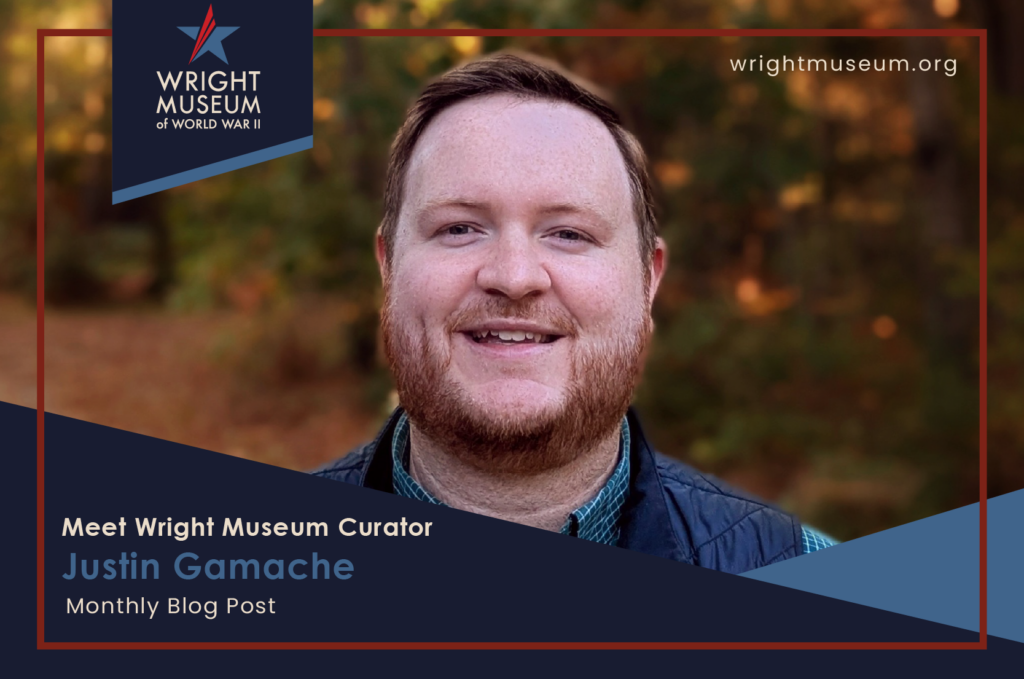
Picture a museum curator, and you might imagine someone in white cotton gloves, alone in a hushed vault, turning a rare artifact over in the dim light. There is a room like that at the Wright Museum of World War II. It is a secure, climate-controlled archive tucked behind two separate alarm systems. More than 20,000 objects rest there in acid-free boxes with the lights off, waiting. But ask the Museum’s curator, Justin Gamache, what he actually does there, and the answer has less to do with gloves and glass cases than you might expect.
“I’m not in the archives all day just playing with cool old historical objects, as much as I’d like to be,“ he says.
Being a curator, it turns out, is mostly about telling stories. It’s about the quieter, less glamorous work of deciding which stories are worth telling and then figuring out how to make people care. After 10 years at the Wright Museum, Justin has become fluent in both.
An Accidental Calling
Justin did not grow up dreaming of being a curator. “Honestly, I didn’t know this is what I wanted to do until college,” he admits. What he did have was a love of history, and it’s a love he discovered early in life. His father is a history buff and his mother a teacher, so family vacations came with an unwritten rule of sorts: wherever the Gamaches went, they stopped at a museum or historic site along the way.
That lifelong pull toward the past followed him to the University of New Hampshire (UNH), where he set out to earn a history degree without any clear picture of what came next. “About halfway through college, I started to think, well, what am I actually going to do with this degree,” he recalls. The answer arrived in the fall of his senior year, when he enrolled in an introductory class in UNH’s then-relatively new museum studies program. “From there, I knew that was what I wanted to get into,” he says.
The timing was almost suspiciously good. That same semester, a small World War II museum over in Wolfeboro, New Hampshire sent a note to Justin’s professor: Did anyone in the program want to intern with them? Justin, who had been visiting the Wright Museum since he was a kid, jumped at it. One internship led to a part-time job while he finished his master’s degree, and that job simply never ended. “I’ve been here ever since,” he says. The boy who once wandered the galleries as a visitor now holds the keys to the archive.
Twenty Thousand Stories and Counting
One of his duties as curator is to plan the special exhibits the Wright Museum creates every season. So where does an exhibit actually begin?
Sometimes it begins with a discovery. With more than 20,000 items in the Wright Museum’s collection, even the curator can be surprised by what turns up. “There’s stuff in the archive that I don’t even know is in there, and I’ve been here for 10 years,” Justin laughs. A forgotten object resurfaces, hasn’t been displayed in years, and suddenly there’s the seed of something.
Other times, the calendar does the prompting. Historic anniversaries and milestone moments give the Museum a natural hook. In 2018, though it’s a World War II museum, the Wright Museum marked the centennial of the end of World War I, precisely because that war led so directly into the next one. The next season marked the 75th anniversary of D-Day. And this year, with the nation celebrating its 250th birthday, the Museum’s lobby traces the evolution of American military uniforms across the entire history of the country.
Not every good idea earns a full exhibit, though, and knowing the difference is part of the craft. The first test is simply whether there is enough to work with. “You have to have more than just one or two small pieces,” Justin explains, “or the idea is better suited to a blog post or an entry on social media.” The second test is harder to measure but more important: The objects have to tell a story. “The most important thing is that the items tell a really unique story, especially when they’re all put together. We need a story that visitors can relate to, and one that leaves them wanting to know more,” he says. “If something they see here prompts them to go home and read a book with more information, then we’ve done our job right.”
To find that story, Justin and his team dig in every direction. They comb their own database to learn what each artifact already knows how to say. They study what other museums have done, borrowing inspiration if not similar ideas. And they turn to the Museum’s research library and primary sources to fill in the rest.
From Sails to Atoms: Anatomy of an Exhibit
To see how it all comes together, look no further than the special exhibit on display this season, From Sails to Atoms: The Portsmouth Naval Shipyard.
Like the uniform display, this exhibit took inspiration from the country’s 250th birthday, as the team went looking for New Hampshire’s fingerprints on American history. They found them at the Portsmouth Naval Shipyard, which during World War II turned out submarines at a pace that still strains belief. But the Museum team didn’t want to tell only the wartime chapter. The exhibit’s title, borrowed from the shipyard’s own motto, captures the fuller arc: from the early days of building wooden sailing ships to the modern era of servicing nuclear submarines. “We wanted to expand it on either end [of World War II] to create the whole narrative,” Justin says.
From concept to opening day, an exhibit like this takes the better part of a year. The groundwork is laid over the summer season; the real construction begins after the Museum closes in the fall. And “construction” is the right word. One of the Museum’s great advantages is a volunteer named Bob Norton, who once worked at the Smithsonian and now builds many of the Wright Museum’s displays. Last year, Bob constructed a curved, tube-like fallout shelter for the lobby. This year, the team looked at that structure and saw a submarine. Justin handed Bob a document full of historic photos and a rough sketch of the idea, and Bob “did his engineering magic,” transforming last year’s fallout shelter into the interior of a submarine under construction, the way it might have looked as it was first taking shape in the shipyard.
While Bob engineered, Justin turned to working on the history: pulling artifacts, writing the text, tracking down photographs, organizing to bring some of the shipyard’s artifacts in for display, and designing it all to look good before it went to print. And none of it happened alone. “It really is a team effort,” he says. Executive Director Peggy Hennelly-Maniates helps weigh which ideas are feasible on the Museum’s budget and timeline. Maintenance man Mike Mead lends a hand with the building. Archive volunteers help find and pull pieces; seasonal interns take on research, design, and label writing; and when it is time to hang everything on the walls, Administrative Manager Donna Hamill and more volunteers pitch in. In a museum with only three full-time staff, many hands are not a luxury; they are the whole model.
Some of the most powerful moments in an exhibit come not from objects but from photographs. Among the images in From Sails to Atoms is a shot from a single astonishing, record-breaking day at the shipyard, when three submarines slid into the water at the exact same moment, with a fourth launched that same afternoon. Three subs in one dry dock, decked out in patriotic bunting, surrounded by a crowd of hundreds. “When you read about how many people it took to build one submarine, and then you look at that picture,” Justin says, “you kind of get a feel for how incredible this was.”
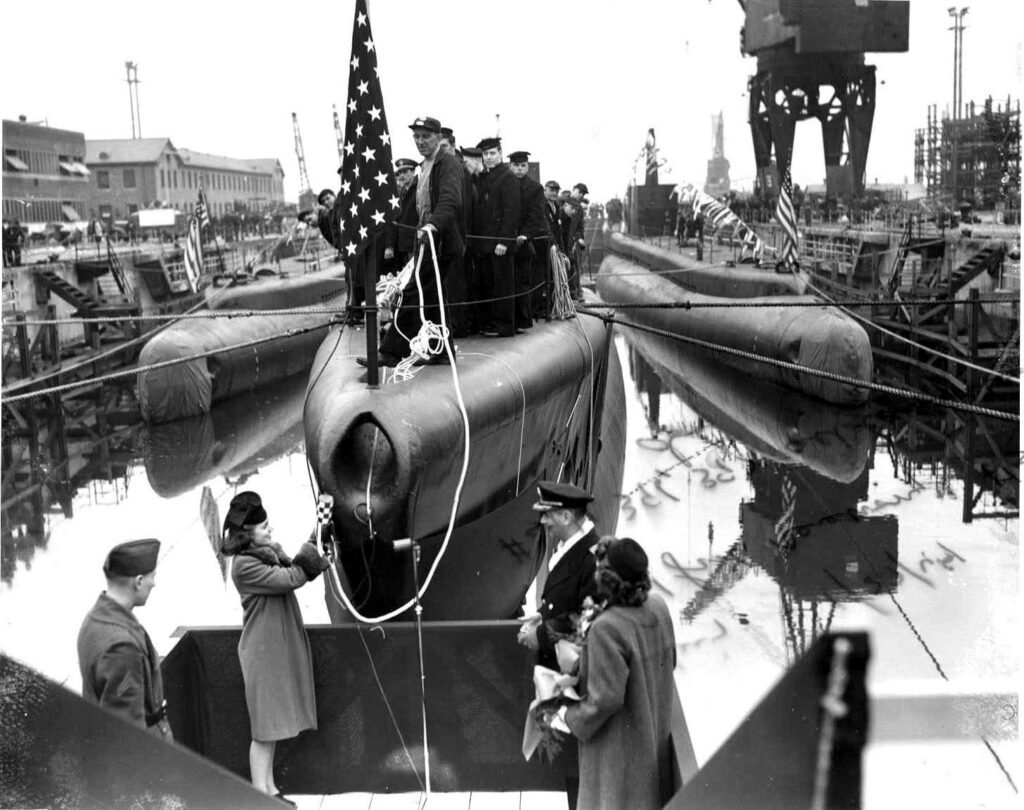
And then there are the artifacts that make the history physical: a life ring from the USS Toro, a submarine built in the yard, and the small ensign flown at the USS Cabrilla’s christening. These are pieces that, in Justin’s decade at the Museum, have never been on display. “When you can see these are actual things that were on a sub that was built here, that really brings it home,” he says.
For younger visitors, the exhibit offers something to do as well as see: a simple balance scale hung with movable tags, paired with text explaining why a ship or submarine has to stay balanced to float or to hold steady beneath the waves. It is a small, STEM-minded touch that the Museum’s executive director carried with her from her days at another submarine museum.
The Art of Making History Personal
If there is a through-line to how Justin thinks about his work, it is this: History lands hardest when visitors can see themselves in it.
Nowhere is that clearer than in the Museum’s Home Front Gallery. Visitors linger at the recreated kitchen and living room, and older guests often stop short. “They’ll actually remember seeing those things,” Justin says, “because their parents’ house had a lot of that same material.” A kitchen becomes a lesson in rationing. It’s a matter of noticing what isn’t there and imagining cooking a familiar recipe without it. A grandparent points something out to a grandchild. The history stops being abstract.
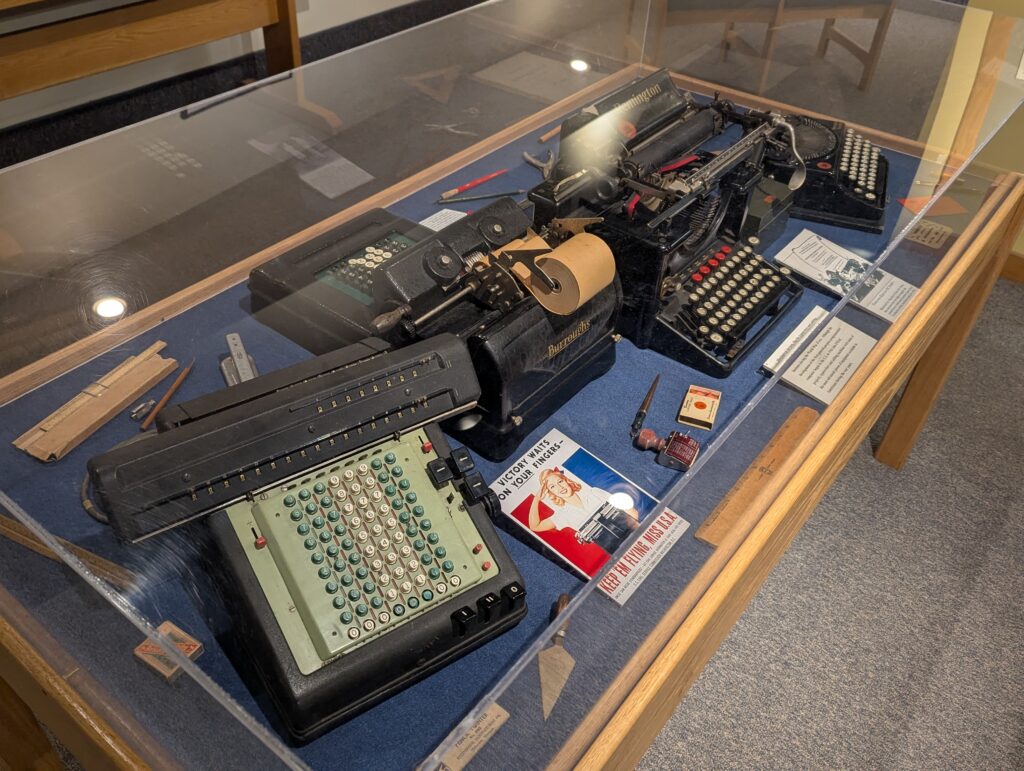
Justin’s favorite example sits in a case of old office equipment: a typewriter, a hulking calculator the size of a cash register, a scattering of slide rules. When school groups come through, Justin likes to deliver a small revelation. “Everything that is in this case, you can now do with the phone in your pocket,” he tells them. The kids, who can’t identify half the objects to begin with, are duly amazed. It is a tiny moment, but it does exactly what a good exhibit should: it makes someone look at the past, and the present, a little differently.
The Unvarnished History
Telling the story of the Greatest Generation naturally means celebrating extraordinary things. But Justin is careful not to let the Museum tell only the flattering parts.
A few years ago, the Wright Museum borrowed a Smithsonian exhibit on the Japanese American interment during World War II. The team wasn’t sure how visitors would respond. “A lot of times when we talk about American history, we talk about the good stuff,” Justin says, “and most of what we did in World War II was on the right side of history. But there were some moments that weren’t so great.” They braced for pushback. Instead, the exhibit resonated. Many visitors had never heard the story, and they left grateful to have learned it.
That experience reinforced a principle that Justin returns to often: “Learning history is important because it helps us do better in the future.” The same philosophy guides how the Museum handles period pieces that haven’t aged well, like wartime propaganda with language that reads as offensive today. Rather than always pulling such items from view, the team sometimes chooses to display them within the context of their era, using the accompanying text to explain both what they meant then and why it matters to recognize and do better now.
What Visitors Never See
Ask Justin about the trickiest part of the job, and his answer is not what most people would guess. “The hardest part is probably having to say no to people who want to donate things to us,” he says. The Museum simply has limits. Limited display space. Limited archival storage. A narrow focus on World War II-era artifacts. The uniform room alone, Justin says, is “packed to the gills,” three racks high and full. Yet requests to donate uniforms come in multiple times a week. “As a curator, I’d love to just take all of it,” he says. “But I have to balance how well we can care for these things.”
It is rarely a simple no. For the families offering them, these are deeply personal pieces of history, and Justin does his best to point them toward a local historical society or another museum that can give their object a home.
What space the Museum does have, it guards fiercely. The main archive sits behind a pair of alarm systems, in a room kept at a stable temperature and humidity by a system built for the job. Objects are stored in acid-free boxes and archival folders; fragile pieces get custom support; the lights stay off when no one is working, to spare everything from UV damage. It is, in a sense, a room designed to slow down time.
Between the donors, the volunteers, the interns, the events, and the occasional Fourth of July parade float, Justin estimates he spends roughly three-quarters of his time working with other people rather than just with artifacts. “Being in a small museum, you wear a lot more hats than your title might suggest,” he says. The trade-off suits him. “You’re never bored because there’s always something new coming up.”
The Payoff
For all the logistics, the reward is disarmingly simple. It is the visitor who wanders in on a rainy afternoon with no particular interest in the past and walks out wanting to learn more.
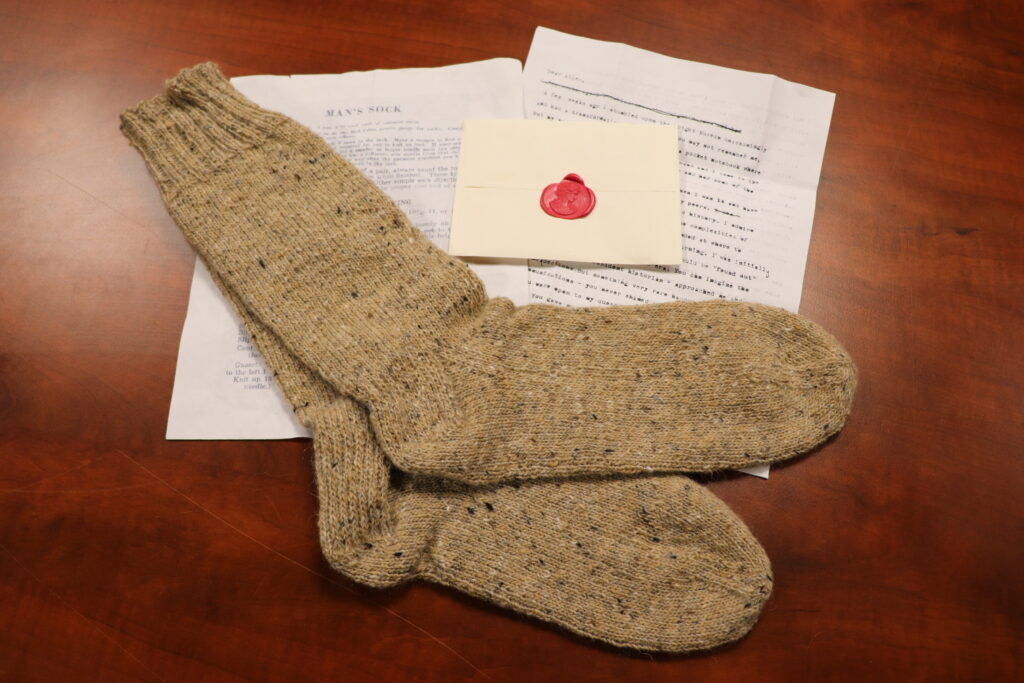
Justin points to a story from last summer. A visitor named Angela who didn’t consider herself a history person got to talking with one of the Museum’s docents, Allen, and came across an old instruction pamphlet for knitting socks to send to soldiers overseas. The encounter stuck with her. As a passionate knitter, she went home, found a period pattern, knitted a pair of socks, and mailed them to Allen as a thank-you. Justin wasn’t there for the encounter, and that is rather the point. “A lot of the time I’m not able to be on the floor with visitors,” he says, “so when I hear stories like that—how a certain exhibit touches someone—it’s nice to know the work you’re doing behind the scenes is reaching them.”
There is a flip side to the hard part of the job, too. For every donation he has to decline, there is the moment a family brings in something the Museum can take. The look on their faces when it goes on display and they return to see it is something that resonates with Justin. “You can tell how important it is to them,” he says. “And it’s important to us too, because we’re keeping that history alive.”
That, in the end, is what he hopes every visitor carries out the door: a sense of just how pivotal a moment World War II was and how much of modern life still bears its fingerprints. “It’s about connecting that to people’s lives today,” he says, “and why it’s so important for them to learn about it.”
What’s Next
If the past is Justin’s medium, the future is never far from his mind. Next season, the beloved Charlie Miller paintings are set to return, as they do every few years by popular demand. After that, the Museum is workshopping an exhibit on what it was like to grow up during World War II. The plan is a blend of pieces: a hoped-for traveling exhibit on the creators of Curious George, who fled the Nazis and escaped Europe during the war; the Museum’s own collection of wartime toys and games; a look at how rationing reshaped childhood, right down to the disappearance of metal toy trains; and oral histories from the Museum’s own volunteers who lived it. As always, the goal is a first-person connection to the past.
This season, the Wright Museum of World War II invites you to step behind the glass yourself. Our special exhibit, From Sails to Atoms: The Portsmouth Naval Shipyard, is on display now as part of our celebration of America’s 250th birthday. You can even step up to a recreation of a World War II-era submarine. Behind every case and every carefully written label is a curator, a team of volunteers, and a story chosen just for you. Visit us during our 2026 season to experience the lessons and lives of the Greatest Generation, brought to life by the people who work quietly to keep them with us.