Tommy doesn’t think of himself as party to history.
He’s 10 years old, he lives in Wolfeboro, New Hampshire. On most mornings in 1943 his biggest worry is whether the ice on Back Bay will still be thick enough for skating after school. But as he walks up Center Street with his schoolbooks tucked under his arm, he is walking through a world shaped by World War II. His school day is shaped by the war, too.
A poster in the hardware store window tells him “Our Boys Need Your Scrap.” A sign in the bank reminds customers to buy war bonds. On the bulletin board by the post office, a neatly typed list of names under the heading “Wolfeboro Servicemen” includes older brothers of kids in his class, a neighbor down the road, and the uncle who used to help his father fix the truck. Tommy reads the names quickly, then hurries toward the Carpenter School before the bell rings.
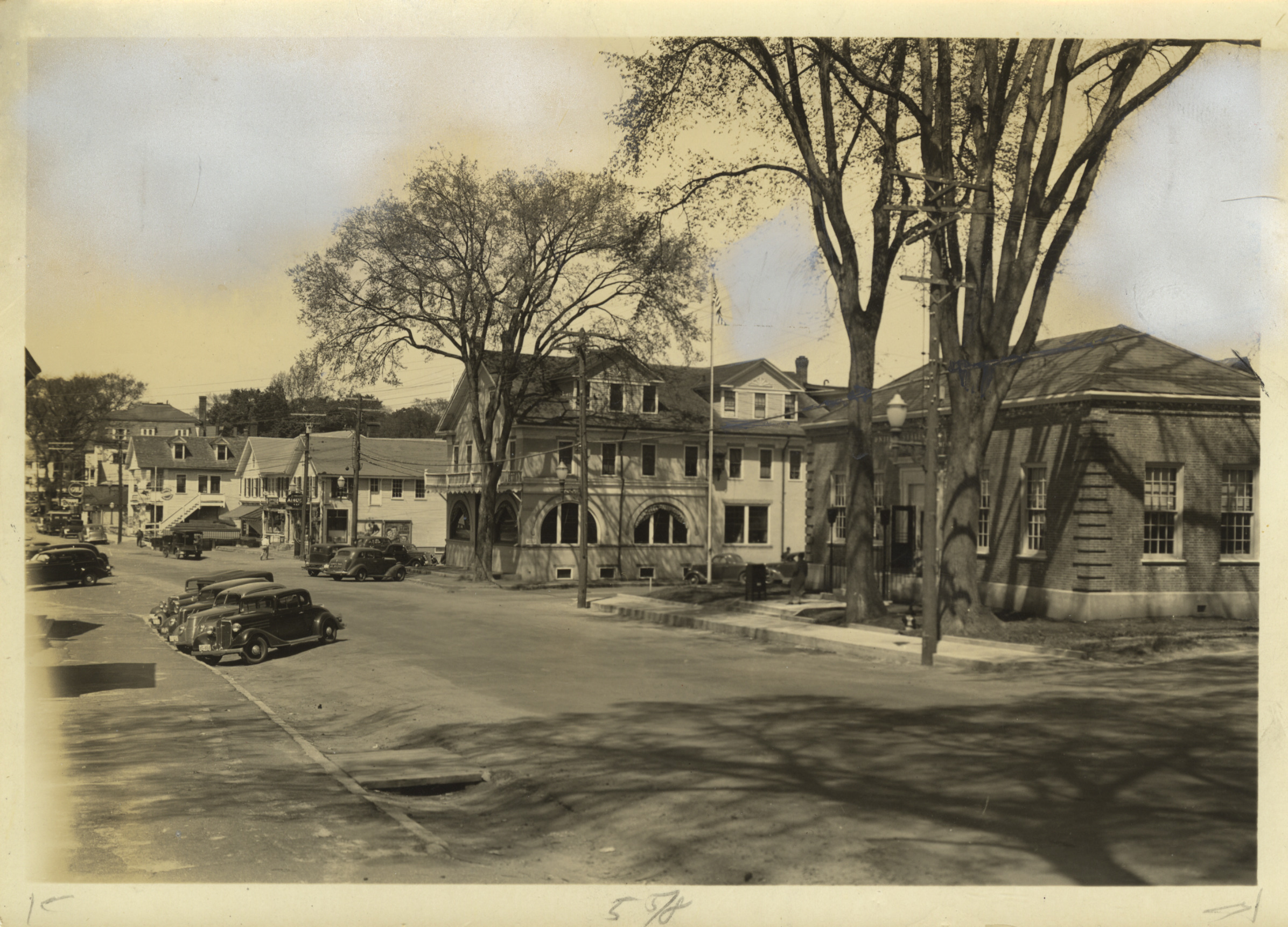
Morning Bell in Wartime
Inside the classroom, Tommy’s day begins much like any American schoolchild’s day did before the war. He hangs his coat on a crowded rack, slides into a wooden desk, and pulls out his arithmetic workbook. His teacher straightens a stack of papers and calls the class to order.
They start with the Pledge of Allegiance and a patriotic song; “America” or “The Star-Spangled Banner,” sung a little too loudly by the younger students who are still excited by the start of every school day. On the wall behind the teacher’s desk, a world map is pinned beside a smaller map of New Hampshire. The state map marks Wolfeboro with a pin. The world map shows the Atlantic and Pacific oceans, circles around distant cities, and red arrows tracing the movements of armies the children have only ever seen in newsreels.
“Today,” the teacher says, “we’re going to use our geography lesson to see where some of our neighbors are serving.” She points to the New Hampshire map, then to the world map, making a line with her finger from Portsmouth, where the Naval Shipyard is turning out submarines, to the North Atlantic. Tommy and his classmates copy names of oceans and countries into their notebooks. Geography, civics, and current events blend together, and the war is the thread that ties them.
Reading, Writing, and “Doing Your Part”
After geography comes reading. The children sound out words from a textbook story, sometimes about pioneers or farm families, sometimes about soldiers or nurses “over there.” Lessons in reading and writing are rarely labeled “war education,” but more and more they carry wartime themes: sacrifice, courage, thrift, and the importance of doing one’s duty.
On the teacher’s desk sits a small metal box that appears a few times a week. When she opens it, the mood in the room changes. This is the box for war savings stamps. Under a national program called “Schools at War,” students are encouraged to buy stamps that cost only a few cents, money earned from chores or saved from allowance.
Tommy waits in line with a few nickels clutched in his hand. When he reaches the desk, he trades his coins for a square stamp decorated with a patriotic image and carefully presses it into his booklet. When the booklet is full, it can be exchanged for a war bond, an investment in the tanks, planes, and ships that the children are told will help bring their fathers and brothers home sooner. The program turns pocket change into a sense of purpose, and for many kids, these stamp books become prized possessions.
On other days, the children collect scraps. They bring bits of metal, rubber, and paper from home, adding them to a growing pile in the schoolyard. Posters explain that these materials will become part of jeeps, helmets, and other equipment for the armed forces. The class competes with the grade above them to see who can gather the most. For Tommy, it’s a game, but he also knows that when the town recognizes the school’s efforts at a community meeting, his parents will be proud.
By November of 1944, students at the Carpenter School will even have bought enough war bonds and savings stamps to completely fund the purchase of a Jeep for the war effort.
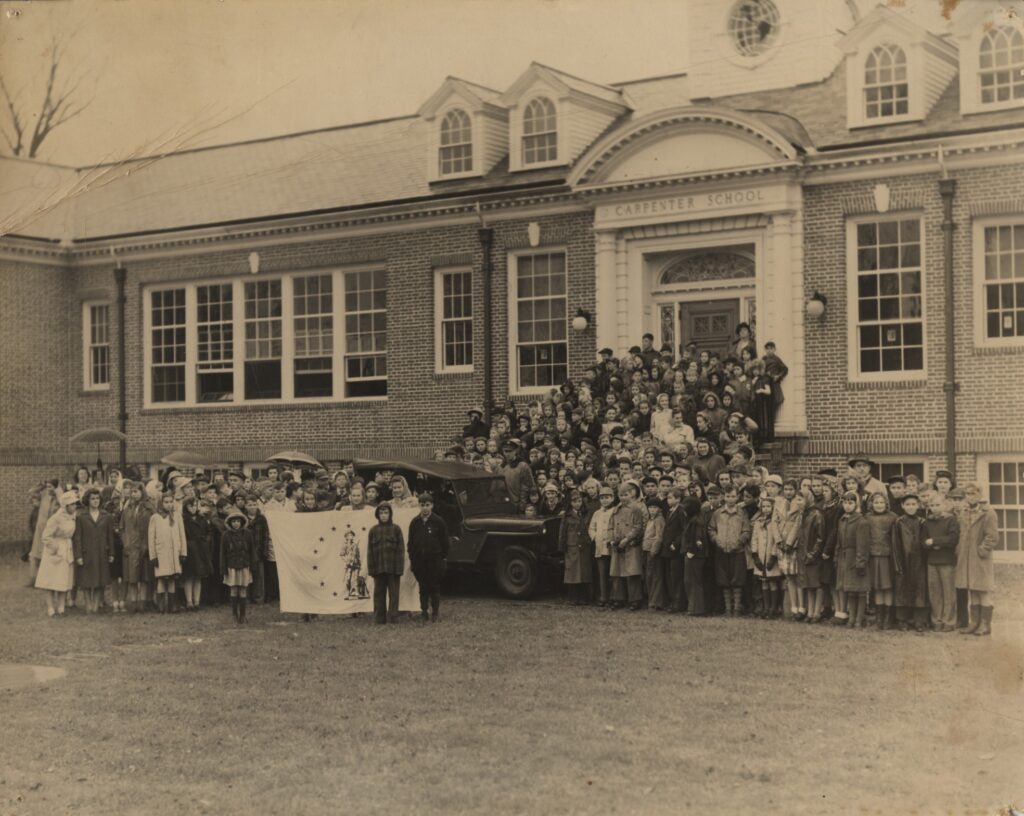
(Photo: Wolfeboro Historical Society)
Air Raid Drills and Blackouts
Just before lunchtime, a sharp sound breaks the routine. It’s not the fire alarm, and it’s not the bell for recess. It’s the town siren.
“Air raid drill,” the teacher calls out. “Under your desks, everyone, and stay quiet until we hear the all-clear.”
Tommy scrambles to the floor, tucking his knees and arms under the desk. He has done this before. The drill is meant to prepare the school in case enemy aircraft ever appear in New Hampshire skies, a possibility adults know is unlikely but cannot entirely dismiss in a world where radios crackle with news of bombed-out streets in London. In some communities, especially near the coast or industrial centers, schools even practice blackout drills, drawing shades and turning off lights to minimize visibility from the air.
The siren wails and fades. For a minute, the only sound is the shuffle of shoes and the low hum of whispered questions. Some students count silently; others imagine they can hear distant airplanes. Then another signal sounds, the all-clear, and the teacher tells them to stand back up and straighten their desks. The drill lasts only a few minutes, but it leaves a mark. The war is no longer just a map on the wall. It is something the students rehearse for on the classroom floor.
Lunchtime Under Rationing
At noon, the children line up for lunch. In Wolfeboro, many children still carry food from home, wrapped in wax paper and brought to school in metal tins. On some days, the school offers a simple hot meal, perhaps a stew or casserole built around local potatoes and vegetables.
Rationing has made food an exercise in creativity. Families have ration books that limit their purchases of sugar, meat, butter, and canned goods. The candy in Tommy’s lunch pail is rarer now; his mother saves sugar coupons for birthdays and holidays. He has learned to drink milk without complaining when there’s no dessert.
At one of the school’s cafeteria tables, Tommy compares his lunch with his friends. One boy’s father works at a farm that supplies produce for the town, and his sandwich is full of fresh greens. Another girl’s family keeps chickens, so she has a hard-boiled egg, an enviable treat in a time when other sources of protein are harder to come by. They talk about the potato crop, about rumors of new ration schedules, and about the latest news from overseas that they heard on the radio the night before.
Rationing reaches beyond the cafeteria. Shoes, clothing, and school supplies are harder to replace, so teachers see more patched coats and mended dresses, and they may adjust expectations when a student’s notebook is already full, but a new one is hard to obtain. Lessons in thrift and sharing are framed not only as good manners but as ways to support the nation. Waste, the children are told, is the enemy of victory.
Empty Desks and New Faces
After lunch, the class returns to math. Fractions, long division, and word problems fill the blackboard. In some ways, this is the part of the day that looks most like prewar schooling; numbers are numbers, and homework is homework.
Still, the war is present in who sits at the desks and who does not. In high school, some older boys have left early to enlist or to work in mills, shipyards, or farms that suddenly need more labor. In many communities, male teachers and administrators have joined the military, and women have stepped into their roles, reflecting the broader “Rosie the Riveter” story of women taking on new responsibilities.
Tommy has noticed that one of the teachers is new this year, a young woman who moved to town from another part of New England. Rumor among the adults says she replaced a man who is now serving overseas. When she talks about the Bill of Rights and the Constitution in civics lessons, she occasionally pauses, searching for the right words to explain why those documents matter in a time of war. The children may not grasp every nuance, but they understand this: Being an American comes with responsibilities, even for 10-year-olds.
In the hallway, there is a small bulletin board with photographs of former students who are now in uniform. When word arrives that someone has been wounded or killed, the teachers decide carefully how and when to tell the class. For the children, the war is no longer just a distant story. It has taken the form of empty desks, new teachers, and serious conversations in the principal’s office.
After-School Work and Wartime Play
When the school week or year is over, Tommy’s work is not done. In the summer and on weekends, he helps on a nearby farm, driving tractors or doing small tasks that used to belong to older teenagers who have gone to war. At 6, 7, or 8 years old, children in some communities find themselves working surprisingly adult jobs, learning responsibility and stamina as part of the home front mobilization. Other students help out in the victory garden at school or their own backyard.
There is still time for playing. Yet even play has absorbed the war. Games of “Cowboys and Indians” have given way to “Germans and Americans” at school recess, and children pretend to be pilots, sailors, or nurses, reenacting battles they heard about on the radio. Four-square and tag continue as they always have, but new rules sometimes reflect wartime themes, “You have to protect your base” or “Your team is the Allies.” New toys are harder to come by. Those that used to be made of metal or wood are now made of cardboard, but the children read articles in magazines about how to make toys out of existing materials at home.
Tommy asks his mother one evening, “What’s on the front page of the newspaper when there is no war on?” He has never known anything else; every headline, every photograph seems to involve soldiers, ships, or leaders in distant capitals. His mother explains that in peacetime the front page holds local news, town meetings, school events, the ordinary business of life. Tommy tries to imagine it.
What Was Different and What Wasn’t
For children like Tommy, school during World War II was both familiar and transformed. They still studied reading, writing, arithmetic, and history. They still worried about tests and report cards, and they still formed friendships, whispered during class, and looked forward to summer vacation. Many of the rhythms of childhood persisted.
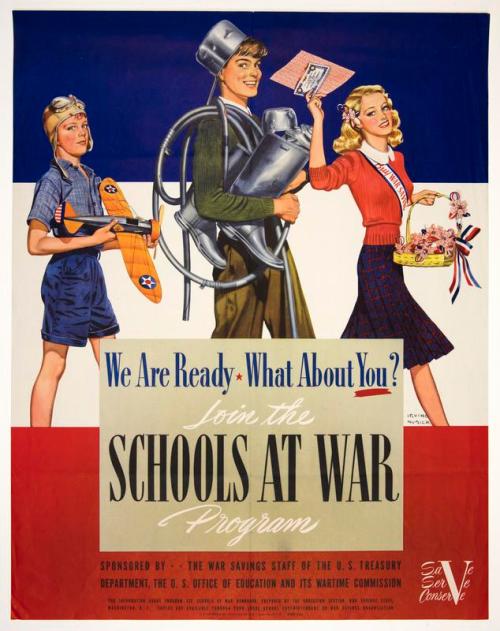
(Poster: FDR Presidential Library and Museum/National Archives)
What changed was the way the war threaded itself through almost everything they did:
- Civics and history lessons focused on democracy, citizenship, and the reasons for fighting, helping students understand the larger struggle.
- Programs like Schools at War turned classrooms into centers of mobilization, where children bought stamps, sold bonds, and organized scrap drives.
- Civil defense drills and blackout practices added a layer of urgency and fear, translating distant danger into physical routines under desks and along hallway walls.
- Rationing reshaped lunches, clothing, and fundraisers, teaching thrift and creativity as patriotic virtues.
In New Hampshire and across New England, these experiences were linked to local contributions, from submarines launched at Portsmouth to crops harvested on family farms and community efforts in towns like Wolfeboro. Children came to see themselves as small but important parts of a vast, shared effort.
From Tommy’s Desk to the Wright Museum
Today, visitors to Wolfeboro can walk just a short distance from the streets Tommy knew to the Wright Museum of World War II, where the home front story is preserved and retold. In the Museum’s galleries, recreated kitchens and living rooms show the rationing Tommy’s family lived with, while displays of office equipment and school materials reveal how much of what once filled a desk now resides in the smartphones we carry everywhere.
Over the years, the Museum has collected wartime games, toys, schoolbooks, and oral histories from men and women who grew up just like Tommy, here in New Hampshire and across the United States. These voices remember air raid drills, stamp booklets, scrap drives, and the feeling of watching older brothers leave for war while they stayed behind, balancing spelling tests with the weight of global conflict.
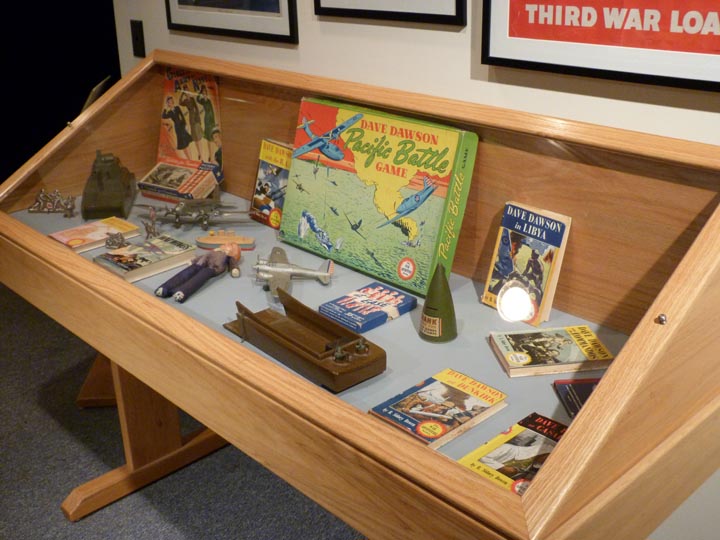
In 2027, the Wright Museum will bring these threads together in a special exhibit devoted to showing what it was like to grow up during World War II. Planned elements include wartime toys and games, stories of rationing, and first-person memories from those who spent their childhood on the home front. The exhibit will invite visitors to step into places like Tommy’s classroom and imagine the sound of a siren signaling an air raid drill.
You will be able to view ration books, look at lunch pails, perhaps see the schoolwork of children who tracked troop movements on wall maps while practicing their multiplication tables. You might stand beside a display of war savings stamp booklets and picture small hands pressing each new stamp carefully onto the page, understanding that even small sacrifices mattered.
For families visiting from Wolfeboro and beyond, the exhibit will offer something personal and immediate: a chance to compare their own school days to those of the Greatest Generation, to recognize what has changed and what has remained constant, and to appreciate how children, too, helped shape the outcome of the war.
When you next walk past the Museum on Center Street, imagine Tommy climbing the steps of his 1943 schoolhouse with a geography book under his arm and a war stamp booklet in his pocket. Then step through the Museum’s doors and see for yourself how his ordinary school day became part of an extraordinary moment in history and how the lessons he learned still echo in our classrooms today.
Selected Sources and Further Reading
“American Elementary School Curriculum During World War II,” Curriculum History (MK Gillaspie, 1998).
“Education for Victory: An Analysis of Social Studies Education in American Secondary Schools During World War II,” Gettysburg College History Department (RE O’Dell, 2016).
“Growing Up on the Home Front,” National Home Front Project.
“Rationing on the Homefront,” National Museum of the Pacific War.
“Children on the Home Front,” Gilder Lehrman Institute of American History lesson plan (includes New Hampshire home front posters and scrap information). “Uniting Communities for War,” The National WWII Museum (home front and community war effort).
Photos from the Wolfeboro Historical Society Digital Archive